Our journey to Gyamtsa would begin by ascending the ridge called Ldungo above Shasthang village. Along the ridgeline, I remember collecting and eating a berry that grew there in abundance. It had a strange name but a wonderful taste, with a soft, jelly-like consistency. We called it ‘Chocho Dugumoe koko’ which literally means ‘the poop of Chocho Duguma’.
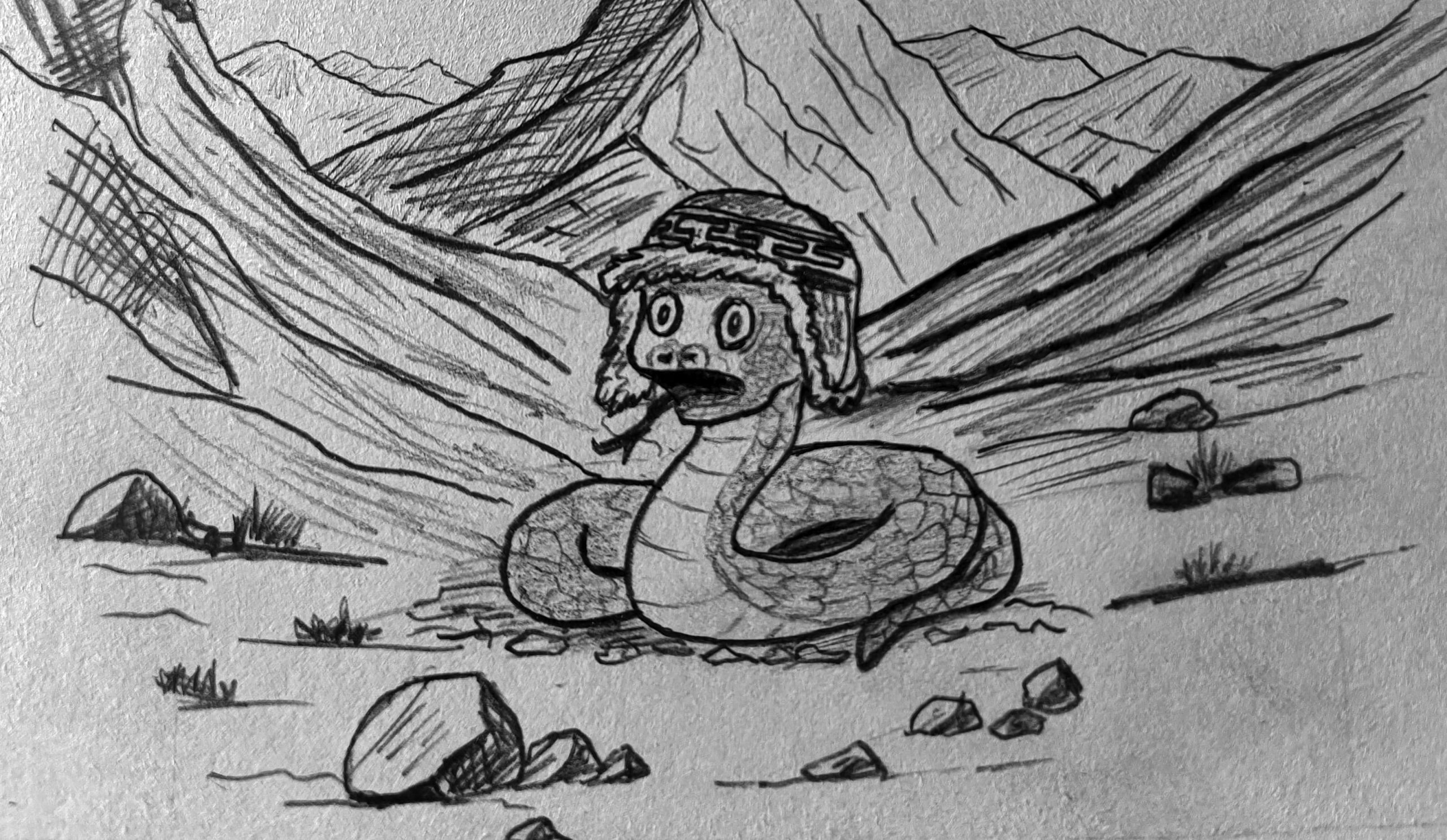
I used to wonder why such a tasty berry had such an unappealing name. I am now deeply impressed by the wisdom of our ancestors as I learnt that it can be toxic when consumed in excess, especially by children. Plausibly, the name served as a simple safety mechanism to discourage consumption of this tasty berry.
As we continued towards Gyamtsa, there was a well-known landmark along the path just before reaching LChhangri Gyamo. A large and heavy stone lay there in a sandy patch of land. We would lift it waist-high and drop it to the ground to hear its unusual metallic sound. According to local stories, a hidden treasure lay buried at that spot. Elders said a Pumpa (vase) had been sealed underground and that disturbing it would unleash fierce winds and terrible consequences. Today, however, the place can no longer be located as road construction has altered the landscape completely. Some would claim that a treasure had been hidden there by the same people who had constructed Tisuru Chorten, which is 500m downhill, to repair and restore the structure in the future. Others claim Gonpa villagers had hidden a treasure there in the past. The village, or a few families from it, once inhabited the gently sloping hillside just above the site. Even today, one can still see old ruins scattered across the slope as silent reminders of the settlement that once stood there.
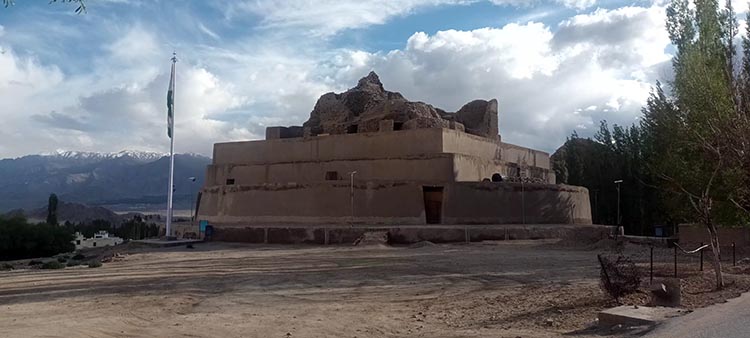
The historic Tisuru chorten
As we walked past, we would greet the Lhato of Lchhangri Gyamo on the right. We would call out loudly, “Solo Solo Lchhangri Gyamo Ne Solo Solo , Kiki So So Lha gyalo!” to praise the deity and pray for protection. Everyone followed this custom. More than a religious ritual, it felt like a shared tradition to express respect to the landscape and gain a sense of confidence as we traversed along the lonely path.
The narrow path clung to the hillside with a steep gorge on one side and a dense grove of poplar trees on the other. It led to a structure perched above a sheer cliff. The dramatic setting has a quiet but powerful story. It is said that a man from a nearby village once climbed there to end his life. Another man saw him and asked to have a word or two before he jumped. As they engaged in conversation, he was grabbed and stopped from jumping off. It reminds us that sometimes a life can be saved by a simple conversation or by just listening.
Just beyond that stood a huge monolithic rock on which nature had etched inverted images of what looked like a bird, a man, a cymbal, and a drum. As children, we called them Cha Golok, Mi Golok, Chimchim Golok and Doongdoong Golok. Near this was a flat stone that we used as a percussion instrument. We would strike it with smaller stones to produce a surprisingly satisfying drum-like sound to entertain ourselves. Since then a road has been built here. The monolithic rock was moved and inverted. Ironically, now all the figures on it appear perfectly straight. Perhaps the rock simply adjusted itself to our topsy-turvy world!
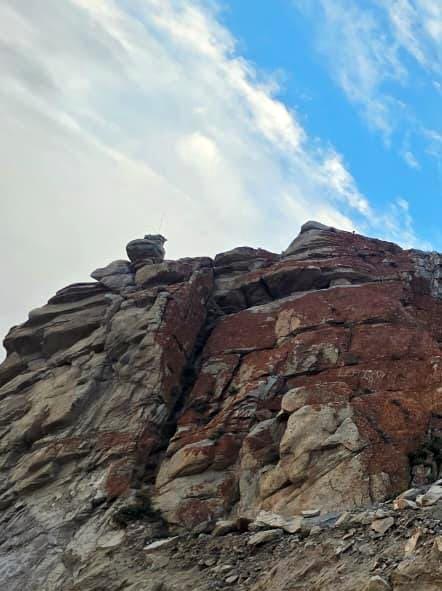
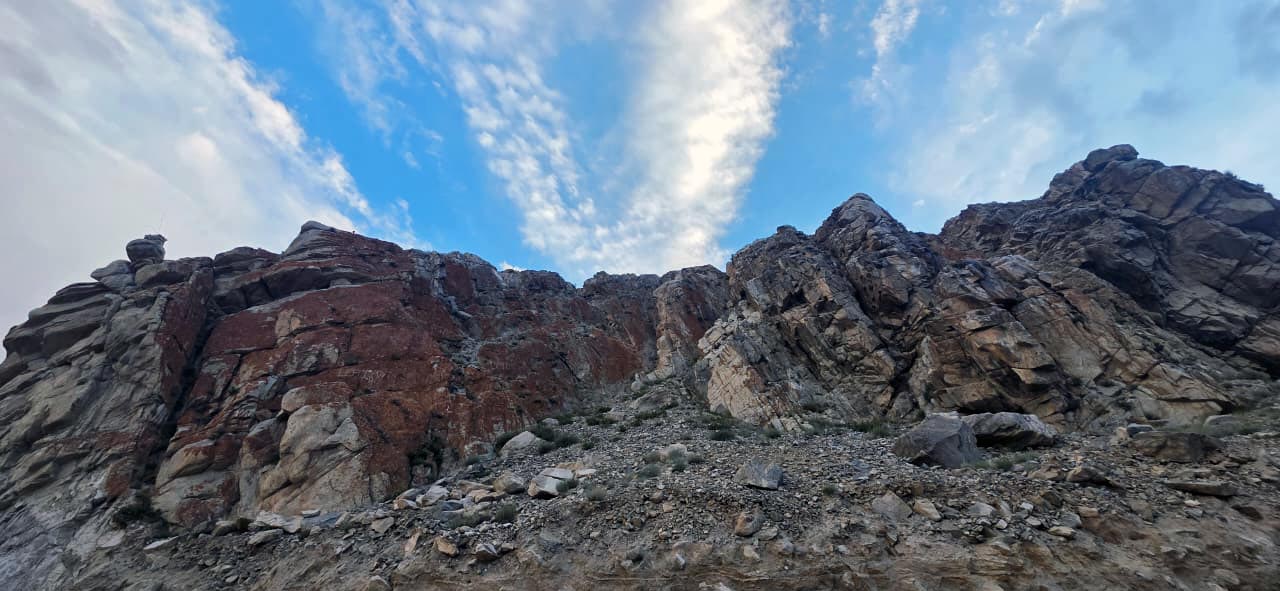
The steep cliffs along the road to Gyamtsa
After this, we would pass a place called Takgyak. At certain times of the year, the local stream here would swell so much that we had to climb the steep hillside to continue our journey. This usually happened at the start of summer when the heat would cause the snow to melt rapidly and flood the stream.
We would cross that stretch before the waters rose, especially when we were herding livestock. It was one of those unwritten rules of childhood journeys in the mountains. We had learnt to keep track of nature and time. My elders mention that the water in streams of Leh would rarely rise before 21 June. In recent years, however, the date has been advancing steadily. This year, it was on 2 June. This is a small but visible sign of a warming climate and the changes unfolding in the mountains.
Lingtse is another place along this path. It had some cultivated lands at the time. The walk to Gyamtsa was not merely a journey. It was also a conversation with a landscape alive with wonderful creatures. We would spend time watching lizards, marmots and other creatures that lived in the valley. Lizards are called Sadag/Sabdag, which means ‘owner of the land’. This espouses respect and acknowledges that the valley belonged to them long before we arrived.
Just west of Lingtse is a valley called Sabuktse. From here, a trail climbs over a pass and descends to Kartsi bago. Today, it appears very disturbed as many rocks and boulders have disappeared and the landscape bears unmistakable marks of off-roading by SUVs. One can imagine the countless nests, burrows and creatures like Sabdag disturbed by such activities.
In the past, Sabuktse was very important. People from my village would visit it to collect lime that was used each summer to whitewash Sankar Gonpa, the chortens and our homes. It was a seasonal activity that tied the landscape, the village and the monastery together.
As we proceeded towards Gyamtsa, we would pass stretches of greenery and cultivated fields belonging to families from Leh. The next valley is called Genis where the path climbs over a pass and proceeds to Phyang and Nubra.At the top of the pass, the view opens out magnificently. This route is still used as a trekking path to Hunder. Genis-la is regarded as the most difficult and exhausting part of the journey to Nubra on this path and makes the trail somewhat challenging.There is a saying that captures this well. “Saro chatpey Genis metpina, Hunder la nyinlok tanin!”, which translates to “Had Genis-la not been there, I would go to Hunder and return in a day”.
Proceeding further into the main Gyamtsa valley, one passes a ridge called Ldung, which has a few cultivated fields. I have fond memories of this place as my grandfather used to spend much of the summer here tending to our donkeys.
At the northern end of the ridge, below the hill above, are ruins of an old structure known as Lhagang, with walls that are nearly three feet wide. Locals claim that it was meant to be a monastery that would be comparable to Alchi monastery if had it been completed. According to folklore, divine beings were building the monastery and intended to finish it before dawn when humans awaken. In the middle of the night, a donkey suddenly started braying. Donkeys generally bray at the approach of dawn though this one called out long before morning. Hearing the sound, the divine builders believed it was daybreak and disappeared to leave the monastery unfinished.
Just opposite to the east is a Lhato called Putuk Gyamo. A narrow valley below Putuk Gyamo leads towards a pass to Horzey and served as a shortcut. Continuing up, beyond the last cultivated fields, is a flat area marked by two large stone towers called Khamthevor i.e. the tower of the Khamba. A little further, the trail reaches the end of Gyamtsa valley at a place called Sumdo, where the valley branches into two narrow valleys. The valley to the left is called Gunchanglas and the one to the right is Yamko. We shall follow the right valley another day. It eventually leads to the base of Khardung-la after passing through many old Pulus. Along the way, we shall uncover many other stories hidden in these mountains!
As someone who has roots in this place and has witnessed it change over the years, I cannot help but wonder if the changes that have happened here could have been managed with greater care to preserve the natural landscape, its aesthetic character, and the spirit of the place. Such development could also consider the animals that live on these lands. Development itself is not the problem as every place changes. I cannot help but wish that those who truly knew the place, or belonged to it, had guided these changes, or at least been consulted and informed. The people of a place often understand what can be altered and what should never be touched. The workers making the changes are simply pursuing a livelihood.
Yet once change becomes permanent, it can only be witnessed and endured. One cannot later justify it by saying “It was not my job” or “I was busy with family and with work.” History does not pause for personal responsibilities. While people remain occupied with demands of everyday life, landscapes, cultures, and memories continue to transform quietly around them. And by the time one finally pauses to look, much has changed forever.
By Dr Spalchen Gonbo
Dr Spalchen Gonbo is a Paediatrician based in Ladakh.