The lingering pain of Partition

The Partition of India and Pakistan was not just a separation of land but also a division of thousands of families. The mainstream discourse on Partition and divided families primarily focus on Punjab, Jammu and Kashmir valley. The pain and anguish of divided families in Ladakh and Baltistan rarely receive a mention. This is a personal issue for me. My grandfather, the late Haji Abdul Hamid (1 December, 1938 to 18 May, 2020) lived with the pain of separation from his father after the ceasefire line was drawn in 1949 to separate India and Pakistan.

My grandfather was born in Padum, Zangskar in 1938. He was the only brother to his three sisters. News of the horrors of the Hindu-Muslim riots that marked the Partition started to reach reached Zangskar valley in 1947. The valley has Himachal Pradesh in the south and Kashmir in the west. These horrific stories ignited fear amongst the minority Muslim community in Padum. A group of men from the community decided to get organised to protect themselves in case the violence reached Padum. My great-grandfather, the late Habibullah was one of these men. In 1948, members of Gilgit Scouts, with support from the newly-formed Pakistan, reached Kargil and a few of them proceeded to Zangskar. In Padum, some members of the Muslim community viewed these individuals with hope in the context of the communally-charged atmosphere in the Indian subcontinent in the wake of the Partition.

We shall keep the story of how this small contingent of Gilgit Scouts survived in Padum for another day. In the summer of 1949, Indian troops managed to push Pakistani forces from Kashmir and Ladakh and they allowed a safe passage to the Gilgit Scouts troops in Padum. Some men from Padum’s Muslim community decided to join these retreating troops. This included my great-grandfather. My grandfather was 11-years-old at the time. Before he could comprehend what was happening, my grandfather was left behind in Padum with his mother and three sisters. The group from Padum travelled with the retreating Gilgit Scouts troops along the Kargil-Skardo road. The letters written by them at the time suggest that they did not intend to settle down in Baltistan but planned to return to Padum once the conflict ended. Unfortunately, the conflict ended with the creation of the ceasefire that separated Gilgit-Baltistan and Ladakh. Subsequent conflicts between India and Pakistan extinguished any hope of their return.

In the absence of his father, all responsibility for the family fell on my grandfather. Once my great-grandfather realised that he was not going to be able to return to Zangskar, he married a local girl in Baltistan and settled in Sermik. The following years were tough for the family as there was no communication between them across the Line of Control (LoC). Slowly, the finality of his father’s absence dawned on my grandfather. He yearned to meet him and the death of his mother within a few years further intensified his pain and anguish. In those days, there were no means to earn daily wages in Padum. So a few years later, after his marriage, my grandfather moved to Himachal Pradesh in search of work. During our storytelling sessions, he would describe this practice of moving out for work. He would mention that the Muslims of Padum would generally travel for work to Chamba in Himachal. Once his children had grown up, my grandfather travelled to Leh to train as a veterinary assistant. He hoped to save enough money to someday travel to Baltistan and meet his father. Once he returned to Padum, he worked as a veterinary assistant as well as an Amchi (traditional Tibetan medicine system) dentist in the absence of doctors in the region. He also opened the first hotel in Zangskar by the name of Hotel Greenland. He would often mention the hotel to his father in letters they exchanged in chaste Urdu. On the other side, Habibullah proudly recounted these stories to his children—two sons and a daughter with his second wife—in Sermik.

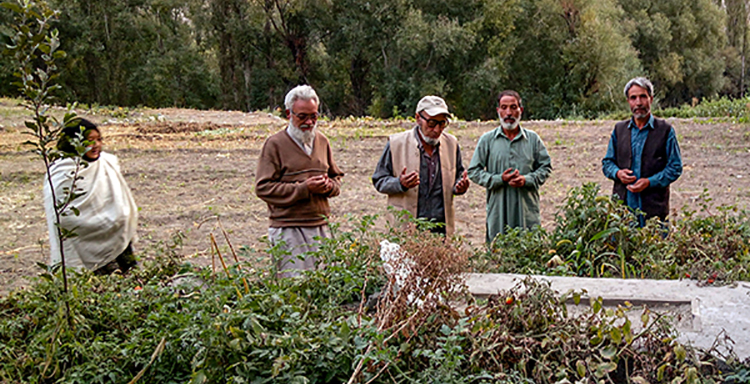
(Above) Haji Abdul Hamid and his step-brothers offering prayers at their father’s grave in Sermik, Baltistan
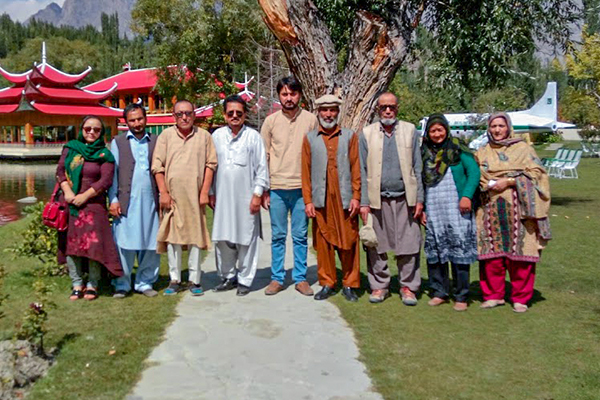
(Top photo) Family members from both sides of the LoC at their reunion in Skardu, Baltistan

The deteriorating relationship between India and Pakistan crushed all hopes that father and son had nurtured of meeting face-to-face. Habibullah passed away on 17 December 1987 with an unfulfilled longing to meet his family in Padum, especially his son. On this side, the death of his father shattered my grandfather. He still did not lose hope and continued exchanging letters with his step-siblings in Sermik. Since there was no formal system to exchange post between India and Pakistan at the time, the only way to send letters and gifts to relatives across the LoC was through Haj pilgrims who would hand them over to pilgrims from the other side. I grew up listening to my grandfather’s stories of pain and anguish in the wake of the Partition. His love for storytelling and my interest in these stories made me one of my grandfather’s closest confidants.

Let us now fast forward to 2009 by which time the internet had started reaching these remote mountain regions. One of my cousins from Sermik was in Islamabad at the time. He remembered ‘Hotel Greenland’ being mentioned by his mother and decided to search for it online. Since the hotel was no longer functional by this time, he found nothing online. He then collected the names of other hotels in Padum and started mailing them to ask about Hotel Greenland. One of these hotels suggested that he get in touch with me. We managed to get in touch with each other and continued speaking over social media. During these conversations, I learnt that our relatives on the other side of the LoC were yearning to meet my grandfather.

This was around the time I had started my doctoral research on the topic that has always fascinated me: India-Pakistan relations. One of my case studies was to understand the impact of theatre groups on cultural diplomacy between the two countries. By 2014, I was able to establish contacts in Pakistan for my study and I was able to accompany a theatre group that was invited to perform at a festival in Karachi organised by the famous theatre activist, Sheema Kermani. It was during this trip that I met with my cousin for the first time in Lahore and he accompanied us for the whole journey. During our time together we started discussing the possibility of organising a trip for my grandfather to visit Baltistan.

Once I returned to India, I kept exploring ways to make this dream a reality. During our conversations, my grandfather would often say, “I have fulfilled all my responsibilities and even performed the Haj thrice. Now, my only wish is to visit my father’s grave.” Around this time I attended an event on India-Pakistan relations in Delhi, where the late Madeeha Gauhar of the Ajoka Theatre in Lahore was also invited. At this event, she introduced me to someone from the Pakistani embassy in Delhi. I mentioned my case to him and he promised to help. In due course, we completed all formalities and in September 2017, my grandfather, parents and me finally embarked on a journey to Baltistan. We travelled along the Amritsar-Wagah-Lahore-Islamabad-Muree-Khyber Pakhtunkhwa-Babusar-top-Chilas-Skardo-Sermik route. It took us almost a week to complete this journey.

A caravan of vehicles from Sermik was waiting to welcome us in Skardo. It was as if the whole village was there to greet us. The moment I saw my grandfather hugging his brothers tightly, I realised that his ‘last wish’ was starting to come true. When we reached Sermik, people crowded around us and kept touching us to check if they were dreaming. I could see questions in their eyes as tears of happiness and sadness mixed freely in the village that night. I was surprised to learn that there is a Padum community in Baltistan—these are the descendants of the men from Padum who had settled there. Those men have all passed away and their families are now scattered across Baltistan but all of them proudly call themselves “Zangskar-pa”.

We visited the graves of many of the men from Padum. For me, it was most satisfying to watch my grandfather visit his father’s grave, which was marked with bold Urdu letters stating: “Habibullah, Padum Zanskar”. There were tears of joy and pain. It felt like a circle was finally complete and his yearnings and pain finally eased after that ‘union’.  The news of our arrival spread like wildfire and from the very next day to the day of our return, we had a stream of visitors from every corner of Baltistan. We also travelled to different areas to meet people from the Padum community and collect their letters and gifts for their relatives in Zangskar.

This was the most emotionally satisfying journey for all of us. We then returned to India and continue to remain in touch with our relatives in Baltistan through social media networks.

The trip to Baltistan happened at the right time for my grandfather. He remained ill for almost a year from 2019. In February 2020, he had to be air-lifted from Padum and admitted to the Sher-i-Kashmir Institute of Medical Sciences in Kashmir. He then returned to Padum and breathed his last on 18 May, 2020 in his beloved homeland.

All said and done, he was most satisfied that he was able to travel to Baltistan. Today, when he is no more, the Padum community in Sermik and people in Padum, Zangskar are together in mourning his passing. After all, he was one of the only people who have been able to make that long and rigorous journey to Sermik to connect the dots and pray at his father’s grave. That journey has set the ball rolling and opened avenues for other families to dare to dream about meeting their relatives on the other side of the LoC.

Photograph and text by Dr. Zainab Akhter

Dr. Zainab Akhter works at the Manohar Parrikar Institute for Defense Studies and Analyses, New Delhi.

A brief history of social distancing in Ladakh and the western Himalayas

Historically, neither infectious diseases nor quarantine are new to Ladakh or the wider Himalayan region. At first sight, this is a depressing topic for research. However, closer examination points to encouraging evidence of human ingenuity. Above all, it reminds us—if any reminder is needed—of the benefits of modern medical care.

Some of the most vivid source material concerns smallpox. Dr Henry Cayley (1834-1904), a member of the Indian Medical Service, was the first fully-trained Western doctor to work in Ladakh: he came to Leh in 1867 as a British ‘officer on special duty’ and ran a clinic alongside his main work, which was to monitor the Central Asian trade routes. He wrote that he saw no case of smallpox in that year but that “ten years ago it spread through the whole country, and killed numbers”. He goes on to explain that the Ladakhis had practised a stark form of social distancing.

He writes, “In former years the custom was to expose the patients with the disease out on the mountain sides, where the friends brought them food, &c. until they either died or got well. It was a somewhat cruel, but, at the same time, admirable, plan for lessening the spread of the disease: and in this climate it would really be better for the sick to be out in the open air, than shut up in a close dwelling.”

On a happier note, he reported that the whole population had been “inoculated by the Lamas” during that period. Since then, the disease had not occurred, except for a few cases in 1866, and the dread of the disease had greatly diminished.

It is not clear precisely what Cayley means by “inoculation”. In the late 18th Century, the British doctor Edward Jenner had pioneered the process of cowpox vaccination. The East India Company veterinarian William Moorcroft, who visited Ladakh in 1820 and 1821, tried to introduce vaccination against smallpox, but was unsuccessful because he was unable to obtain a sufficient quantity of active vaccine from his friends in India. Meanwhile, Lobsang Yongdan has mentioned that Tibetan scholar Jampel Tendzin Trinlé (1789-1839), widely known as ‘Tsenpo’, wrote about vaccination in Jenner’s sense, as early as the 1830s. However, the Ladakhi lamas who were inoculating in the 1850s may have been practising variolation, a procedure in which a healthcare practitioner immunises an individual against smallpox using material taken from a patient in the hope that a mild but protective infection would result from this exposure.

In any case, both Western and local practitioners combined to spread knowledge of Jennerian vaccination in the western Himalayan region from the mid-19 Century onwards.

Another example from 1867, the year that Cayley was writing from Ladakh, concerns the Moravian missionary Eduard Pagell (1820-1883) who served in Pooh, Kinnaur. In February 1867 a messenger from the Totso valley in the neighbouring region of Western Tibet arrived to say that the area was suffering from a smallpox epidemic, which had already wiped out several families.He asked the missionary to come to their aid or no one would be left at all.

Pagell had himself been sick in bed for three days but he duly set out on the five-day journey to Totso. In one village of 23 houses, 60 people had caught the disease and all but a few had died. In another place, those infected by the disease had taken refuge in a cave some distance away—following the same ‘quarantine’ technique as the Ladakhis—where they languished without any care at all. Pagell gave what help he could, visiting 12 villages and vaccinating 639 people.

On this emergency visit, Pagell was welcomed wherever he went and many of his patients recovered but he was never able to repeat the journey. When he tried to do so in the summer of 1867, he found that the Tibetans had broken bridges on the main paths and placed watchmen at the border with orders to shoot anyone who tried to enter the country from Kinnaur; the whole country was in quarantine.

In Ladakh, both the knowledge and the practice of vaccination continued to spread. In 1880, British Joint Commissioner, Ney Elias (1844-1897) wrote about a monk named Sonam Tandup who would collect smallpox vaccines from the British dispensary. He would then travel from place to place for most of the year administering the vaccine. He had conducted 634 vaccinations in 1877, 347 in 1878 and 445 in 1879. He received no salary for his service, and Elias asked his superiors to give Sonam Tandup Rs 15 for his work over the previous year.

Today, we again need to implement quarantine and social distancing but smallpox belongs to the past. One day—we hope soon—COVID-19 will likewise be a distant historical memory.

By John Bray

Photograph by Rigzin Chodon

John Bray is a historian. He is currently based in Singapore.

The human immune system

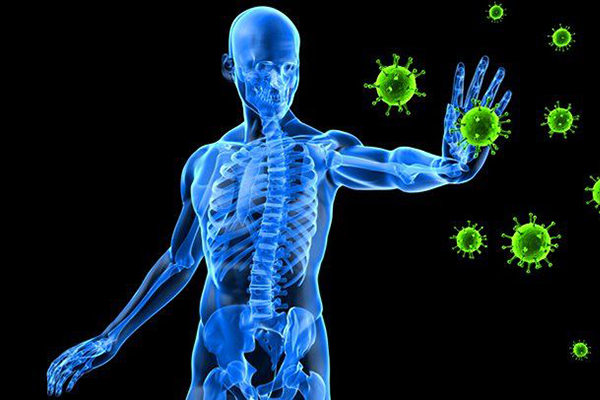
In the wake of the coronovirus, there is a lot of discussion about the human body’s immune system. The immune system or immunity is the human body’s strong in-built defence mechanism.This immune systemis a collection of cells and various organsthat work together to form the body’s defence system. The organs that play a key role in the immune system include the spleen, bone marrow, lymphatic system,etc. Together all of them manufacture cells such as white blood cells (WBCs), which are otherwise known as leucocytes, phagocytes, T lymphocytes, and B lymphocytes.

The B lymphocytes and T lymphocytesare manufactured in the bone marrow. Once they have been created, the lymphocyte cells may remain in the bone barrow and become B lymphocytes. Others go to the thymus gland, situated in the neck on the thyroid gland, where they undergo ‘commando’ trainingand become T lymphocytes. These T lymphocytes are known as killer cells. The B lymphocytes serve as the intelligence gathering arm of the immune system. They locate the invader, including ones that are new to the body, judge the kind of damage it can cause to the body, orders the soldier cells (T lymphocytes) to go to the site and kill the invader. The order is followed immediately and the antigen (something new to the body) is destroyed. The specially-formed force of antibodies remainson alert in case they are needed again. Thus whenever an antigen enters the body, the immune system uses a diversity of forces to counter the invasion.

In my opinion, most Ladakhis have a strong immune system. The reason I make this assumption is that till about two or three decades back, the lifestyle in Ladakh was rather tough and to an extent, unhygienic. We lived along with our livestock and often drank from the same water sources. The current drinking water supply system is relatively new. Children would play with sheep and goat, which we assumed would help them stay warm. Children would play in the streets through the day, while the adults worked in the fields or herded the livestock for grazing. Irrespective of everything else, very few people, be it an adult or a child, were in the habit of washing their hands. And when people did wash hands, it was generally with plain water as soap was a luxury.

In comparison, people in developed countries have been living in relatively sterile conditions. For instance, they would not be sharing drinking water with their livestock like we did till fairly recently. Even their cattle live in relatively sterilised conditions!

In January 2020, I visited Vietnam with my son. We crisscrossed the country from Hanoi in the north to Ho Chi Minh in the south and also visited other places like the Mekong river delta. We ate a lot of Vietnamesefoodacross the country including street food. Even the street food was so sterilised that I started to suspect that the immune system of the average Vietnamese must be relatively weak. We stayed in a good hotel where hygiene and cleanliness were a priority. Unfortunately, such living standards decrease the body’s immunity even if we would have inherited some generic immunity. However, that is a discussion for a different time and place.

There were no cases of coronavirus in Vietnam while we were there. However, as we reached India, coronavirus was starting to appear on the news. As a precaution, my son and I visited Sir Ganga Ram Hospital in New Delhi where many of my batch mates are practicing. There both of us were tested and checked and received a clean chit.

In Ladakh, till the recent past, most of us were economically impoverished and lacked various facilities, clothes, food, warm living facilities, access to medical facilities etc. Most of us relied on traditional medicinal practitioners like the Amchi to cure various ailments. Despite this material poverty, people were eco-friendly and innovative.

At that time, small pox was the most horrifying communicable disease that a person could contract and many people died of it. Once someone contracted small pox, he or she would not be allowed to remain at home. They would be takento a designated place such as nearby cave or facility. They would remain here and be given food and water once or twice a day. Here they were left on the mercy of the gods like a wrecked ship in a storm. Amazingly, some patients did recover from this dreaded disease and would return to the village to rejoin normal life.

Infants and new-borns would generally be kept in hand-made half-open woollen bags called Tsemboo. Dried and powdered goat dung would be placed in the Tsemboo. A stone would be put in fire and when it was warm, it would be placed in the goat dung. Once the dung was warm, the stone would be removed and the baby would be placed in the Tsemboo. When a child would get a delicate bruise, we would apply fine goat powder where people today apply talcum powder. Infants were actually fed, if not intentionally, very small quantities of tetanus and gas gangrene. Both of these are deadly diseases that are caused by various Clostridium sp bacteria. However, when a very miniscule amount of sub-clinical dose of the organism entered the body of a baby, it would trigger the immune system to manufacture counter measures against this antigen. This would provide a degree of immunity that would remain in the body for a lifetime.

At the time, pregnant women would work in the agricultural field, take livestock grazing in the mountains and perform all sorts of heavy tasks. There are stories of ladies giving birth in a field, in the mountains or wherever they were working when the labour pain started. The delivery would sometimes be done by the mother alone or with the help of other ladies if they were present at the time. The child would then be brought home in a Tsepo (a multipurpose traditional basket) with grass covering the baby. Once home, the mother would be allowed to rest and be fed nutritious food for the next few weeks. There were no medical facilities at the time and there are reports of some ladies losing their lives during childbirth.

In the past, the used powdered goat dung would be thrown in the field as form of manure. In contrast, we nowadays use disposal diapers. Unfortunately such diapers are expensive and harm the environment when they are disposed. It is rare to see someone wash and reuse cloths napkins nowadays. Furthermore, the use of powdered goat dung also helped prevent, or atleast reduced the incidence, of some deadly diseases.

As an ENT specialist, I have seen only one case of tetany and that was in a non-local labourer who had a minor injury on his finger on which he had applied soil. In another case about 20 years ago, there was a patient from Garkone who had a superficial head injury on which he had applied fresh cow dung. He died in Sonam Norboo Memorial Hospital in Leh.

I have seen horrible wounds on different body parts. Many of them were not cleaned while others had tried to apply a burning cloth piece on it or dung powder or soil. Many of these wounds would heal and only leave a scar. Once in the 1990s, a labourer came to me with a horrible wound on his foot. He had managed to hit his foot with a pick axe, which had cut through the shoe and made a deep cut through his foot. He insisted that I just do a dressing to stop the bleeding. He refused to allow me to give him an injection of T. Toxoid and also did not agree to take antibiotics and pain killers. He was confident that he had the mental and physical strength to recover. In fact, he did not return to change the wound dressing for several days. I was rather surprised but his wound healed but left an ugly scar that does not seem to bother him.

These are things we can continue discussing and studying. During this time of crisis, we must remain hopeful. Please don’t panic or get stressed as this will only suppress your immune system. All of us must adopt all the precautionary and preventive measures advised by medical science and directed by Government of India. Hopefully everything will be fine soon but we must remember this episode as a warning sign to correct our errant ways.

By Dr (Kacho) Akbar Khan.

Dr (Kacho) Akbar Khan is a retired Ear, Nose and Throat (ENT) specialist and is based in Kargil.