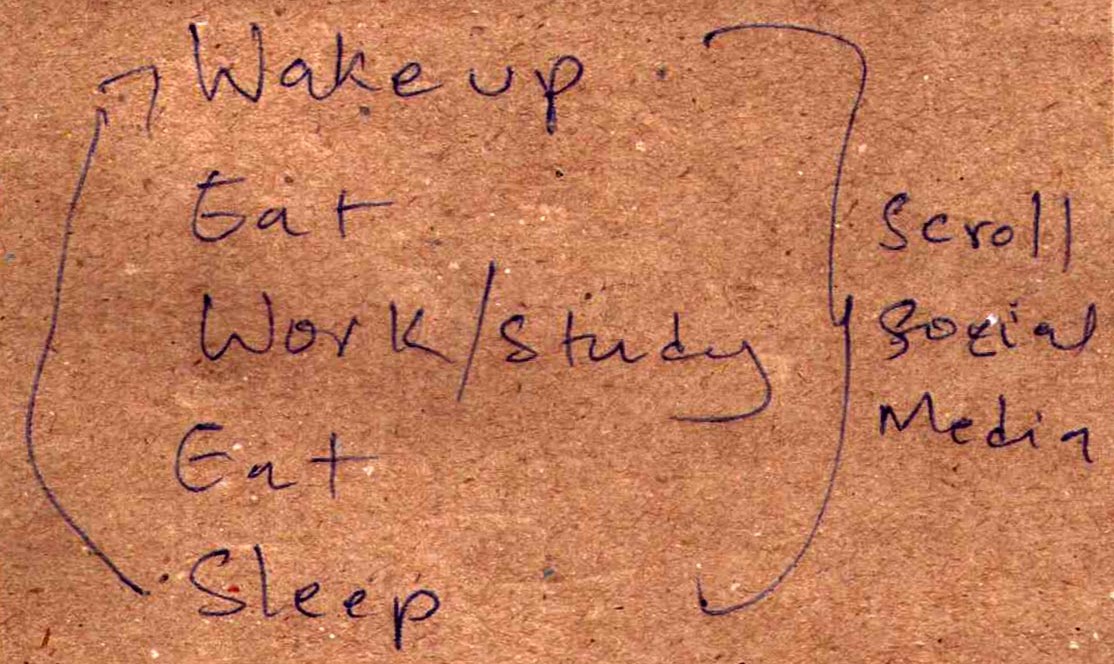
The most dangerous place to be is inside a moving vehicle that you forgot you were driving. For instance, the morning seems to know what you will do. The alarm rings. You don’t wake up. You are summoned. You reach for the phone without opening your eyes or thinking. You scroll for seven minutes, maybe 10. You wouldn’t know. Then, bathroom, commute, work, whatever food is quickest, more screen-time, and finally, sleep. And the next day, repeat this again. Nobody planned it this way or sat down and said, “This is the life I choose.” Yet, here it is playing out like a pre-recorded script on loop. You are living on auto-mode or what engineers call ‘self-drive’. The car moves but no one is steering it.
In school, you had a lunch box someone packed for you, a bag someone bought for you, and a seat someone assigned to you. Life had walls painted by somebody else’s hand. Then, it ended. College arrived with its own confusion. Now you have a degree to finish and a career to start akin to building and sailing a ship at the same time, in a storm, with people watching. You are no longer in school but nobody told you how to be an adult. You are caught in a gap where half your friends post job offers while the other half repost memes about existential dread. In this confusion, autopilot quietly clicks on.
You don’t choose the routine, it chooses you. You follow the schedule because everyone around you does. You chase a job because you are supposed to. You sign up for certification, internships, and networking as the next step in the process. One process follows another. The quiet pull of what everyone is doing.
This is a force more powerful than any other. It has no name but everyone knows it well. Call it peer gravity. The invisible pull of what everyone around you is doing. Your batchmate gets a good placement and your restlessness sharpens into panic. Your neighbour’s son gets a government job. Your parents mention it at dinner and before long, you are applying for jobs you had not thought about or wanted as it is terrifying to stand while everyone else is moving.
This is ancient human wiring. We are tribal creatures and look to others to know if we are safe and on the right path. The tragedy is that the group is looking at another group, which is looking at another, and the original compass has been lost. This is called social proof in psychology, where humans revert to the actions of the majority when faced with uncertainty. The problem is that the majority may also be uncertain, just moving faster.
Something occurs rather quietly after you have been on auto-mode long enough: Nothing new happens. New things, people, and ideas keep emerging but you stop noticing. You have trained yourself to see what is expected, hear the familiar, and reach for what is comfortable. A child sees a pigeon and loses their mind with wonder. An adult on autopilot sees it and thinks: Pigeon. No further processing required. Neurologists call this habituation. When a stimulus is repeated, the brain devotes less energy to it. It is efficient. It is also tragic. The brain applies this logic not just to pigeons but also to sunsets, conversations, people, and your life. You don’t even realise you have stopped feeling. You just call it maturity.
What nobody tells us about auto-mode: Values start slipping. Not dramatically but slowly, like coins falling through a hole in a pocket you didn’t know about. You are kind but increasingly conditional about it. You are honest but selectively. You believe in hard work but increasingly only when it is being watched. You care about the world, but rarely enough to inconvenience yourself for it. Society runs on values the way a city runs on electricity. Most people don’t think about it until it’s gone. Integrity, empathy, patience, and courage to act: These are not words on a school poster but the operating system of a life with meaning. But when you are on auto-mode, who has the time to check about the operating system? We generally wait until something breaks.
Nobody gets off auto-mode in a moment of revelation. That only happens in movies. Real life is quieter. It starts with a single, underrated act: Noticing. Say, you notice that you reached for the phone before you reached for yourself, agreed to something you didn’t want, or realise it’s been months since you did something that made you happy. Noticing is not a cure but it is the first time the autopilot hears a hand on the wheel.
The gap between “I want to live intentionally” and “I need to survive this semester” is vast, confusing, and occasionally delayed for no reason. Here is the honest, embarrassing truth about stepping off autopilot: You don’t know where you’re going next. The autopilot at least had an endpoint plugged in even if it was a bad destination. It was something. It had a route. It had an ETA. Your relatives could track it. The moment you switch it off, you are suddenly standing in a parking lot, keys in hand, staring at the open road, and realising you haven’t eaten, don’t know where you are heading, and your phone is at 11% battery. This is normal. Nobody tells you this part. The movies skip it entirely. You will probably have yours during a 45-minute power cut in your hostel room, sweating, and staring at the ceiling.
A 2022 study found that people who quit autopilot routines without a plan report feeling ‘temporarily more confused but eventually more alive.’ The keywords here are ‘temporarily’ and ‘eventually’. Nobody specifies how long it takes: It could be a week, a semester or the whole of your 20s.
This is a journey you have to take. Not because someone said you should but because you were feeling that quiet, uncomfortable itch. The sense that something is off and that you are performing a life rather than living one. You might not know what to do with that feeling. Most people don’t and they scroll past it, open a new tab and look up something unrelated like “How long do turtles live?” The answer is a surprisingly long time, which will make you feel better and worse simultaneously. You don’t need to know the destination to take the wheel. You need to stop pretending the car is driving itself. You need to see your own white-knuckled hands on the wheel.
Drive confused. Drive slowly. Drive in the wrong direction. It is better than sitting in the passenger seat and telling yourself that the car knows best. It does not. The car is a machine, you are not. You don’t need a five-year plan. You just need to be more awake tomorrow than you were today. That’s it. The bar is that low and somehow worthwhile. There is a version of you, which is not far away. Who wakes up one morning and notices something. Maybe the way the light hits the wall, a conversation that took an unexpected turn, or a task that makes you happy. In that moment, you will be driving. You won’t know how it happened. You won’t be able to explain. But you’ll know.
You are not broken or failing. You are like every human who has ever lived, running on habit, fear, and the momentum of other people’s choices. The truth is that the wheel is right there but you become comfortable in the passenger’s seat. Routines will build themselves around you. But inside, there is still a version of you that craves things that are interesting. Find that person again. Not for productivity, success, or happiness but to say, “I am behind the wheel.”
By Rigzin Wangchuk
Rigzin Wangchuk is pursuing an under-graduate course at Punjab University, Chandigarh.