
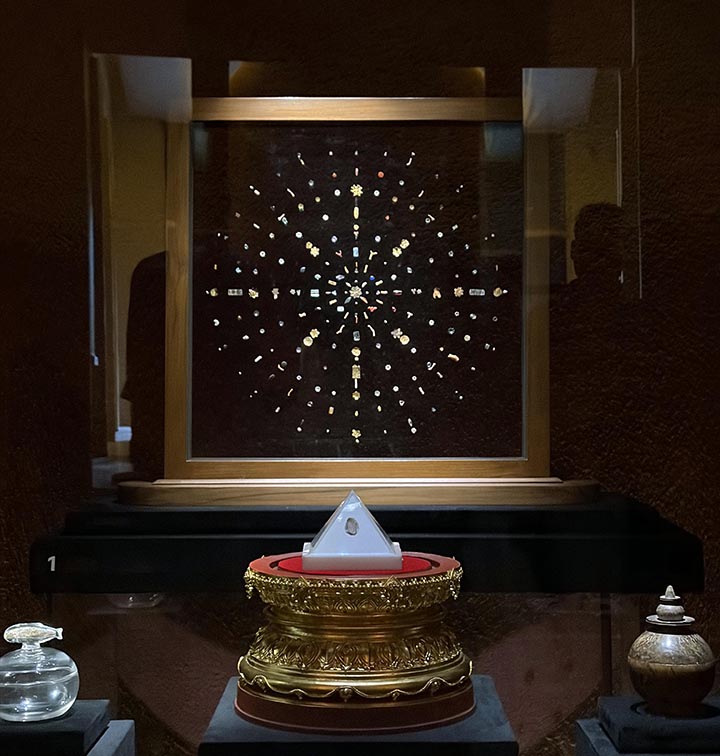
In January 2026, I visited Delhi. Along with seeing many famous places, I was fortunate to attend a special exhibition that displayed the sacred Buddha Relics. Being a Buddhist, this particular visit felt like a pilgrimage.
The exhibition explained that after the Mahaparinirvana of Gautama Buddha, his body was cremated. The sacred relics that remained were then divided into eight portions. Each portion was given to a different kingdom and clan that deeply revered the Buddha. They built stupas to enshrine these sacred remains so that people could offer prayers and pay homage. These stupas became important sites for pilgrimage and a reminder of the Buddha’s teachings of peace, compassion, and enlightenment.
The exhibition was devoted to the Piprahwa Relics, whichwere unearthed from a stupa in Piprahwa in present-day Uttar Pradesh. It is believed to be the portion given to the Sakyas of Kapilavastu. It was unearthed in 1898 by British Engineer, William Claxton Peppé and it was subsequently taken overseas. In May 2025, descendants of Peppé tried to sell the sacred relics at an auction in Hong Kong. Government of India’s Ministry of Culture managed to halt the auction and declared the relics as India’s inalienable heritage. Thus, in July 2025 the relics returned to India after 127 years.
As I watched the relics, I felt that Government of India has made a sincere effort to bring these precious relics back from various countries around the world and saved them from being auctioned. I read that this was done through a unique collaboration between the Godrej Group and the Ministry of Culture, Government of India. I have often heard the word ‘secular’ being used to describe our nation and in connection to our Constitution. However, during this visit, I felt that I was witnessing true secularism in action.
The exhibition venue itself felt very special. It was set on a large green lawn near the Qutub Minar. A beautifully designed structure had been constructed, which looked like a chorten (stupa). Later, I learned that the design was inspired by the famous Sanchi Stupa.
When I visited, there were very few people present at the site. Because of this, an attendant personally guided me and showed me the sacred relics and other precious articles displayed at the exhibition. This made the experience even more personal and memorable.
I also came to know that the exhibition had been inaugurated, a few days prior to my visit, by the Hon’ble Prime Minister of India, Shri Narendra Modi. As a Buddhist, I felt deeply grateful for the effort taken to organise such a meaningful exhibition. The visit left me with a sense of peace, pride, and spiritual connection. It was an experience I will always cherish.
Stanzin Dechen is currently studying in Class 10 at Ladakh Public School.
Samstan Sponbo is passionate about photography, with a keen interest in wildlife and astrophotography.
Text by Stanzin Dechen
Photograph by Samstan Sponbo