Changing place names: Nubra

Most place names in Ladakh have historical, geographical, cultural, social or religious meaning. Most place names are associated with features of the landscape, such as water bodies, rock formations and biodiversity in and around the village. Over time, these names have undergone varying degrees of change from slight variations to complete corruption. As a consequence of this change, the original meanings of many names have been lost.

Sometimes the change has been towards an easier pronunciation. However, more often names have been corrupted by Border Road Organisation (BRO), when they depict them on milestones. Over the years, I have collected explanations and interpretations of place names from oral history and published literature. There are possibly several other interpretations, which need to be researched and documented. Here, I present some village names from Nubra valley.

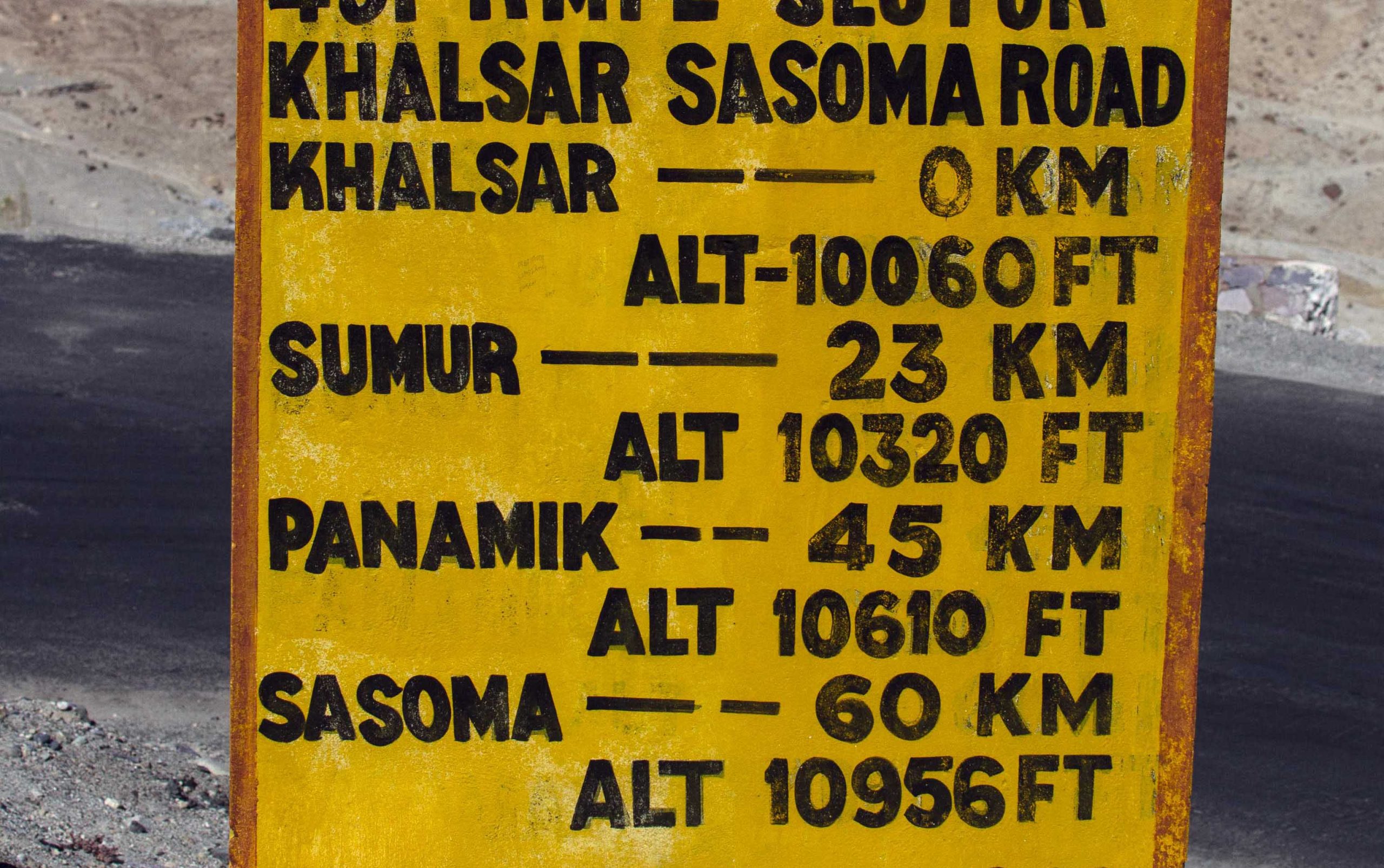
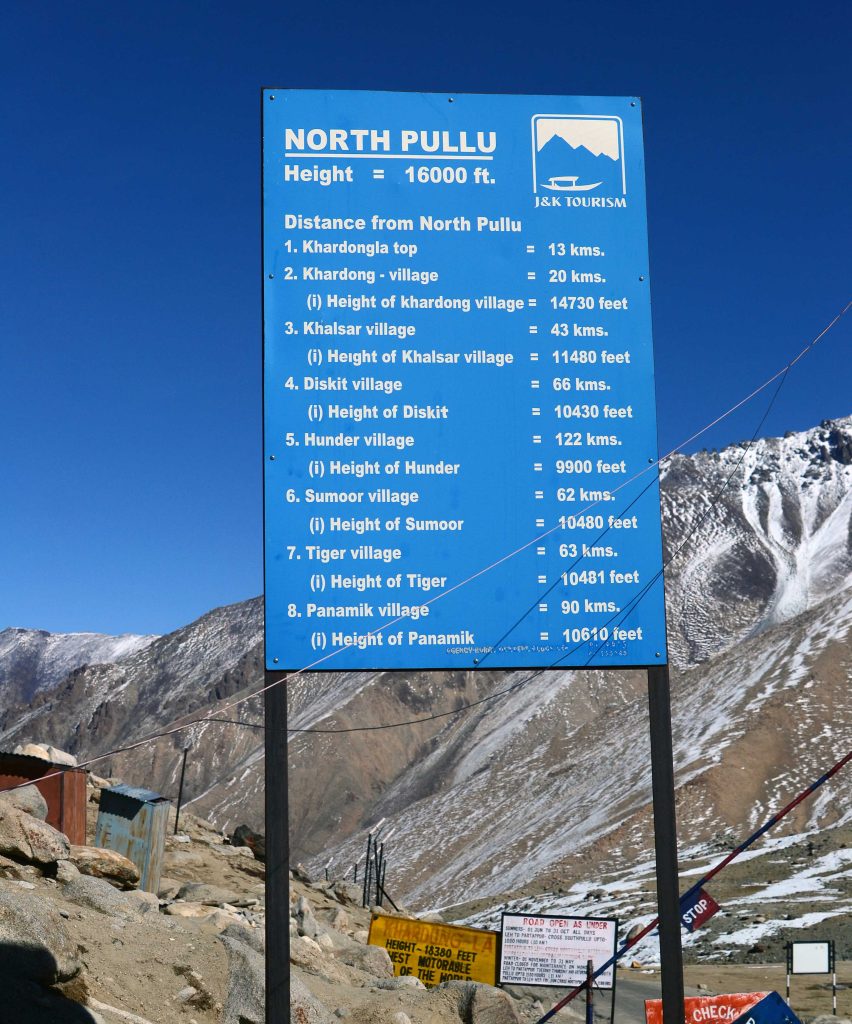
Measuring a tiger? Village names from a BRO board in 2015 (Photograph by Jigmat Lundup).

Sumoor: One explanation links the village name to Sum-yur, meaning three irrigation channels. This is supported by the fact that the village is irrigated by three irrigation channels even today. Another explanation suggests that the name is derived from sum yul meaning three settlements based on the knowledge that in the past, the villagers lived at two other places in the valley before settling at the present site. The ruins of the two settlements are located in upper reaches of the valley. Today, the name has changed slightly and is spelt interchangeably as Sumoor and Sumur.

Tegar: The original name of the village is said to have been ldeb-dkar meaning white plateau. Another explanation is that the valley of Nubra resembles a sleeping demon and the mKhar (palace) was located near the demon’s navel (ltea). Thus, the, village was called lte-mkhar. In time, this changed to Kyagar, Tegar and, more recently, Tiger. Locals still call the village Kyagar, while BRO’s milestones proclaim it as Tiger, which is also repeated in official survey maps. This is probably the most extreme change recorded amongst village and place names in Nubra.

Murgi: This name is derived from the mountain above the village: Dngul translates as silver and ri is mountain. According to the book Nubre Nas-shad (Nub-ra’i gnas-bshad) by Urgyan Rigzin, this mountain has white lime (dkar-rtsi) and possibly some silver deposits. Hence, the village was called Ngulri (dngul-ri) or ‘silver mountain’, which subsequently changed to Murgi.

Khardong: This village name of Khardzong is derived from the ancient palace (mKhar) and fort (rDzong)—whose ruins are still evident—at Yuldoma in the lower part of the village. In time, the name changed to Khardong, which BRO and the Indian Army have changed by spelling it K-h-a-r-d-u-n-g on their milestones and souvenirs.

Pinchimik: The original name of this village was spang chhu-mig meaning ‘a spring emerging from a meadow’. According to oral sources, there was a beautiful meadow around the village, which was a favoured picnic spot for King Nyima Namgyal, whenever he stayed at Charasa palace. The name has now changed to Pinchimik.

Tertse/Terchey: The original name was said to be gter-sa meaning ‘treasure or storage place (for sacred monuments)’. According to Nubre Nas-shad (Nub-ra’i gnas-bshad), there was a sacred Gomang chorten in the village, which contained sacred manuscripts and precious relics. The name has been altered slightly and is commonly called Tertse or Terchey.

Khalsar: In the past, the agricultural lands of the village are said to have been owned by a noble family from Nubra. The village was thus called Kharsa, where mKhar means ‘palace’ and sa is land. The name has changed over time and is now called Khalsar.

Khimi: The original village name is said to be skid-mi-gling, whichmeans ‘village/place of happy people’. It’s not clear how this name was changed to Khimi.

Kubet: There are two popular explanations for the name of this village. According to one, the village is located at a place that resembles the shape of Kumuda (water lily). The second explanation argues that people would source stones for pottery from this place. The specific stone was called Kvod by Balti potters, which later became Kubet.

Lakjung: The name of the village was legs-gzhung, which means ‘centre of prosperity’. The village is believed to be one of the earliest settlements in Nubra and has a history of prosperity. The name has changed slightly to Lakjung, though some maps spell it as L-a-z-u-n-g.  

Skampuk: This village was originally called Gan-Phukor ‘settlement of old people’. According to one story, the village was established by an elderly couple, which gave the place its name. Another interpretation is in the The Nub-ra’i gnas-bshad, which explains that the area was very dry (sa-skam) and had a sacred meditation cave (mtsams-phug) of Lama Samstan Chosphel. It is believed that the village got its name through a combination of two words, skam and phug

Chalungkha: The original name of the village was Chu-lung kha, which describes a place at the edge of a valley with water: Chhu-lung: valley with water, kha: opening or front.

Chamshen: This village name is derived from the self-emanated formation of Chamba Gonbo (Maitreya Buddha) in the upper reaches of the valley. The original name is said to have been Cham-Chhen (Great Maitreya), which has now changed to Chamshen.

Charasa: The original name of this village was lchags-ra-sa, which means ‘an iron estate’—the mountain above the village has iron deposits. People from the village used to produce iron goods, including cooking utensils, iron stoves (lchags-thab), iron ladle (lchags-thum), trivet/tripod (lchags-sgyid) and tools for agricultural activities.

Digar: The original name of this village was bru’i-khal (a load of grain) as the village produces large quantities of high quality barley. The name has now changed to Digar and sometimes spelt as D-i-g-g-a-r.

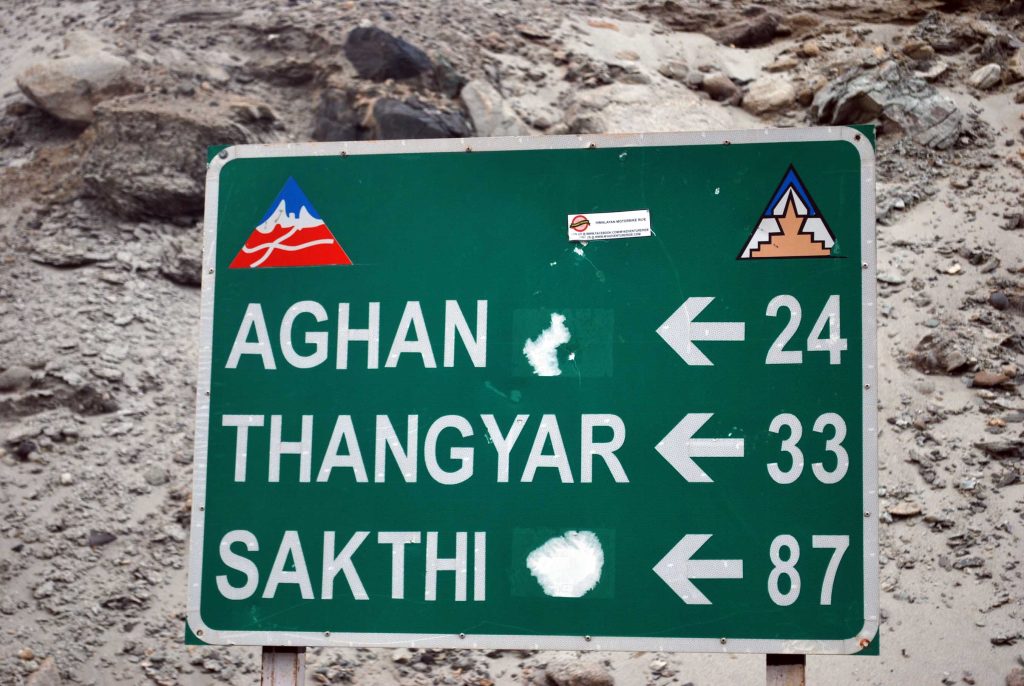
Another BRO board in Nubra (2015). Sakthi/Sakti has been corrected to Ser-thi in signboards around the village after active intervention by villagers (Photograph by Jigmat Lhundup).

Tangyar: The original name of the village was Brang-gyar meaning ‘hired halting place’ and is now popularly called Tangyar. This is sometimes misspelled as T-y-a-n-g-a-r.

Henachey: The original name of this village was dbyen-gnas chhe, which means ‘great solitary place’ but has now changed to Henachey.

Hunder: The village was originally known as sngon-dar meaning ‘the earliest growing (village)’. Hunder, Deskit and Lakjung are said to be the earliest settlements in Nubra. Today, the name has been changed to Hunder.

Udmaru: The name of the village is derived from the outline of the village, which looks like a flower called U-dum ba-ra, which is mentioned in Tibetan literature as a large lotus.

There are other village names that have remained true to their origins, including Tsati (hot springs: tsa: hot, ti: water), Deskit (Dewa and skitpo, which mean happiness/peace), Taksha (derived from a medicinal plant by the same name), Lagyab (behind a pass: la: pass, gyab: behind), Rongdo (beginning of a valley: rong: valley, do: beginning) etc. Other village names like Tirit, Agyam/Agham, Panamik are difficult to interpret. Their origins are possibly in Hor-skat (Turki and other Central Asian dialects) as Nubra is located along the routes that connected Ladakh and Central Asia. I have not studied the village names of Turtuk, Tyaksi and Bogdang but hope to explore them in the future.

By Dr. Sonam Wangchok

Dr. Sonam Wangchok is founder secretary of Himalayan Cultural Heritage Foundation and the Editor of Heritage Himalaya.

End of an era: Tashi Rabgais (1927-2020)

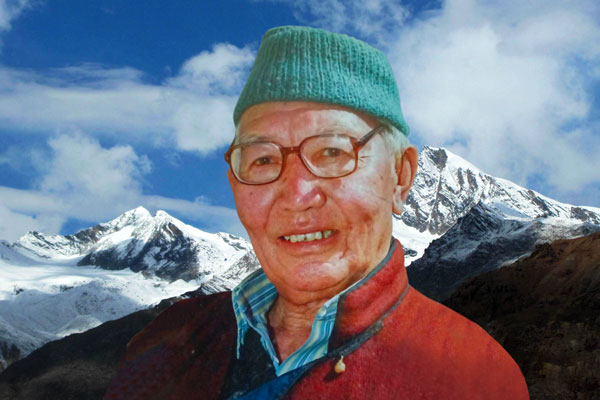
Tashi Rabgais was a prominent scholar, historian and one of Ladakh’s great intellectuals. Despite all his achievements, he was always humble and down-to-earth. He had great command over Ladakhi language and Buddhist studies. He has written numerous books and research papers including The History of Ladakh called the Mirror which Illuminates All. His contribution to the study of Ladakhi culture is immense and innumerable. He worked closely with many national and international researchers, scholars and students. In many ways, he served as a bridge between ancient and contemporary study of Ladakh.

Tashi Rabgais was born in the Tukchu family in Serthi (Sakti) village of Leh district in 1927. He completed his initial education from a Primary School in Chemde village and secondary education from Tyndale Biscoe School, Srinagar. Later, he completed B.Sc. degree from Sri Pratap College, Srinagar.

Tashi Rabgais started his career as the Personal Assistant to Ladakh’s first Deputy Minister in the J&K Govt., the 19th Kushok Bakula Rinpoche, from 1953 to 1958. He then worked as an Assistant Editor/Cultural Officer in Gangtok, Sikkim. After this, he served as the In charge for Ladakhi Programmes on Radio Kashmir, Srinagar from 1960 to 1962. Then in 1963, he was appointed Lecturer in the department of Buddhist studies at Delhi University. In 1964, he was appointed Secretary of Ladakh Buddhist Association (LBA) and worked there for the next seven years. At the same time he also worked as Information Officer, J&K Government from 1964 to 1982. In 1986, he was appointed Education Officer at Ladakh Ecological Development Group (LEDeG). In the 1990s, Tashi Rabgais represented J&K state as a member of the Sahitya Academy, New Delhi and as an Advisor to the Ministry of Culture’s North Zone Cultural Association, Government of India. He was also one of the founding members of the International Association for Ladakh Studies (IALS). He has a Chair in the name of Gyalwa Lungchen Rabjam at the Central Institute of Buddhist Studies, Leh in recognition of his services to Buddhist studies.

He started several newsletters such as Yargyas Kongphel and Tendel Sargyur in Ladakhi language. He authored five books including Natir Puja (1961, play translated from English to Ladakhi), History of Ladakh from early times to 1947 in Ladakhi, and a translation of Ancient Futures to Ladakhi, He curated a collection of 127 Ladakhi folk songs, which was published by J&K Academy of Art, Culture and Languages in 1970. Similarly, a collection of articles in English titled, ‘Ladakh Tradition and Change’ was published in 2004. In addition, he published a collection of 115 original songs written in Ladakhi, which was titled ’Jig-rten Kuntu Gawey Lu in 2007. In 2003, he published the first edition of a play titled Zosgar Tus kyi Melon, where the characters are all wild animals and the story talks about the problems faced by wildlife. In 2003, he wrote a book called Mangs kyi Ringlugs on democracy, In 2009, he wrote a book titled Sustainable Spirituality in Buddhism. In addition to all this, he has made immense contribution towards developing text books in Ladakhi for schools in the region.

Tashi Rabgais had great love for Ladakhi culture and his contribution for preserving culture, language and literature was appreciated by government and non government organisations. In view of his contribution towards preserving Ladakhi language and culture, the J&K Academy of Art, Culture and Languages conferred him with the Robe of Honour in 1971. In 1999, he was awarded the Bhasha Samman by Sahitya Akademi for his multiple achievements. He was also honoured with the Dogra Rattan award in 2007 by the Council for Promotion of Dogri Language, Culture and History, Jammu and Voice of Millions, New Delhi. He was conferred with the State Award for Literature by the J&K Government in 2008. The Ladakh Autonomous Hill Development Council (LAHDC), Leh honoured him with the second Ladakh dPal-rNgams Award in 2017 for his exceptional contribution in enriching Ladakhi language, literature and culture. Over the years he was felicitated by several local and national organisations.

My association with Tashi Rabgais goes back to 2010 when we invited him to inaugurate the office of the Himalayan Cultural Heritage Foundation (HCHF) at Lonpo House in Leh’s old town. Speaking on the occasion, Tashi Rabgais emphasised the value of preserving and promoting various cultural activities for the betterment of society. He was also the patron of the International Association for Ladakh Studies (IALS) and I used to visit him often. Each time, I was impressed and inspired by his wisdom, advice and sense of humour. One day, some of us went to meet him for an interview and he kept telling us “Aap Watan Tumare Hawale Hain Sathiyon” (the nation is now your responsibility). Later, he explained that he has done what he could in his lifetime for Ladakh’s culture and literature and now it’s the responsibility of the present generation to carry that work forward.

In 2019, we invited him for the inaugural function of 19th IALS conference held in Leh where he was felicitated. As the patron of IALS, he delivered a speech, which may have been one of his last public speeches for an international audience. In his speech, he recalled his experience working with various scholars and the contribution of IALS to different fields of Ladakh studies.

Tashi Rabgais passed away on 28 October, 2020 in Leh. His passing is a great loss not only for Ladakh but also for the larger Himalayan region and the world of research. This was well articulated by former president of IALS, John Bray in his condolence message. He said, “More than anyone else that I know, Tashi Rabgais would have qualified for the title of ‘scholar sage’, deep in his scholarship, broad in his wisdom, and all the time full of humour.” We have lost a champion of Ladakhi culture and a treasure house of knowledge. He remains an inspiration for us to take pride in our identity.

Text by Dr. Sonam Wangchok

Photograph by Sonam Gyatso

Dr. Sonam Wangchok is President of International Association for Ladakh Studies and Founder of Himalayan Cultural Heritage Foundation