
Uncovering lost eras in Tiling

We had a remarkable experience during our research expedition to the Rongo area in Changthang’s Nyoma block in 2025. We met a village elder, Tsewang Palgay who mentioned a valley between Tiling and Ngyuguchan on the route to Dungti. He said the valley is scattered with desert-varnished boulders and stones with etchings and markings made by ancient humans. These rock surfaces bearing petroglyphs stand as silent testimony to the lives that once animated the high altitude landscapes of Changthang.

Guided by Kaga Palgay, we visited the little-known Tiling valley where he pointed out the petroglyphs that had remained hidden, undiscovered, and unappreciated for centuries. The valley is spread over an approximate area of 434,278 sq. m. The petroglyphs revealed an extraordinary range of motifs including Dong (Figure 1) i.e. wild yak, which are much larger than domestic yak, ibex, snow leopards, lizards, hunting scenes, and symbolic markings. While many of these motifs mirrored familiar themes also seen in Sham and Nubra valleys, others were strikingly distinctive.
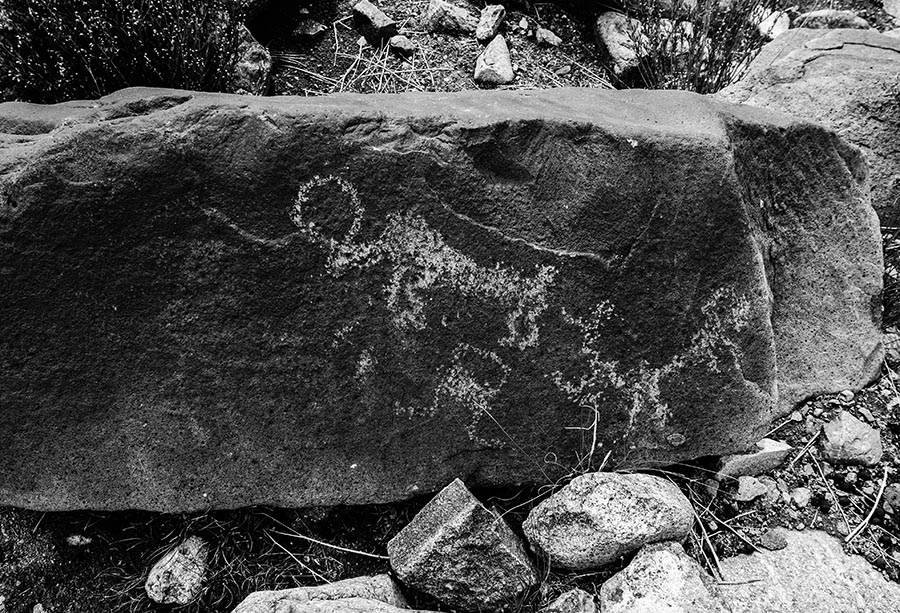
Figure 1: Dong motif

One particularly remarkable boulder had a heavily pecked depiction of what appeared to be a gathering (Figure 2). The carving portrays a human figure in a gown-like dress topped with a hat, raising his arms high above his head. Surrounding him are several other figures in what seems like a circle along with some animals. Near this procession, the presence of animals—especially the Dong, illustrated with its distinctive large horns and uplifted hump to emphasise its massive torso—further enriches the narrative conveyed by the stone.
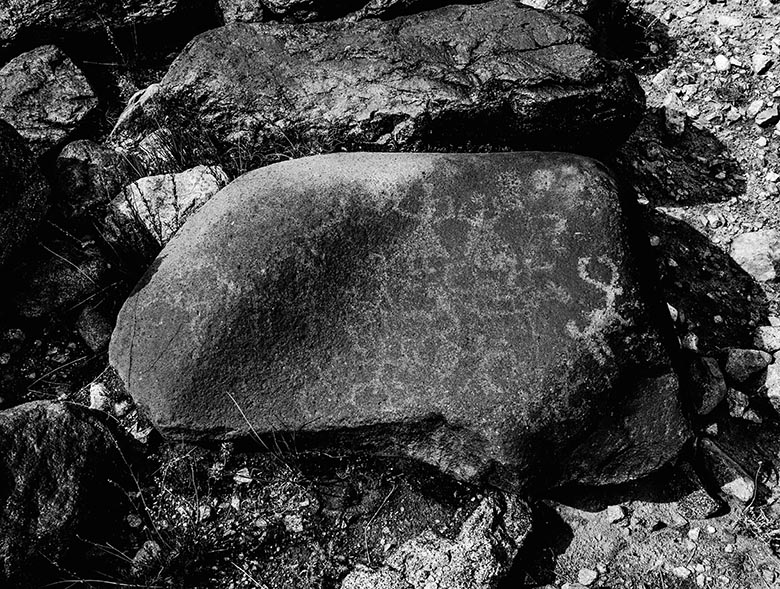
Figure 2: A gathering

Another unique finding was on the edge of an elongated rock where a human figure was etched with his hand raised with an enlarged palm raised towards the sky and his arms piercing past what seems to be an animal carcass (Figure 3). This scene was very distinct as it resembled a hunting scene as he carried his bounty on his shoulder and extended his arm to pierce through it.
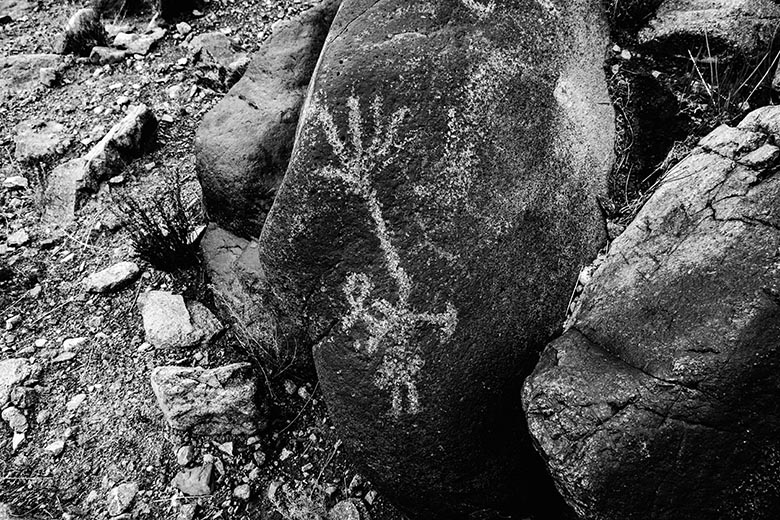
Figure 3: Human figure with enlarged palm

There was also a scene of what seemed like a sword-fight with each member carrying a shield-like tool in one hand and a stick or sword in the other (Figure 4). This scene was made in rudimentary style by scratching the surface of the rock instead of pecking it. This piece of art seems to be more recent than the rest.
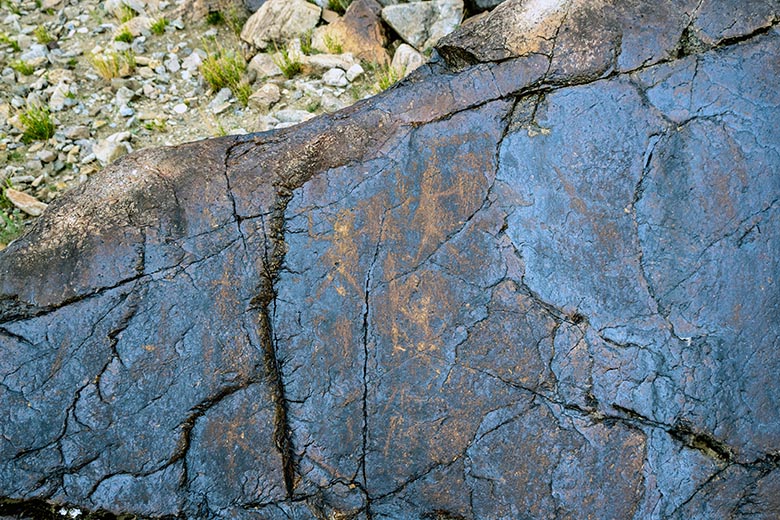
Figure 4: Sword fight

There were also spirals, ladders and geometric representations drawn, which indicated some form of spiritual belief system. We also observed a representation of a mythical being that wore a helmet with horns and its torso had geometrical shapes including diamonds and circles. It also had long, bent legs and spread-out toes resembling a lizard (Figure 5).
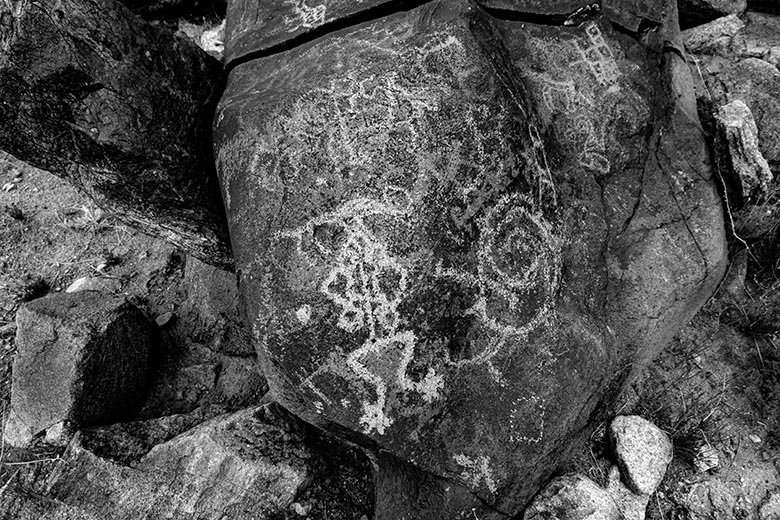
Figure 5: Mythical beigs

The most fascinating find was a pair of anthropomorphic figures riding on the back of an animal that seems to be a later addition to the rock, which had an older zoomorphic figure with multi-tined horns (Figure 6). The zoomorphic figure was done earlier as it has sun-tanned etchings. The landscape of Ladakh has no records of such an animal though there are records from Tibet and Kashmir of an animal called red deer (Hangul in Kashmiri), which has such horns.
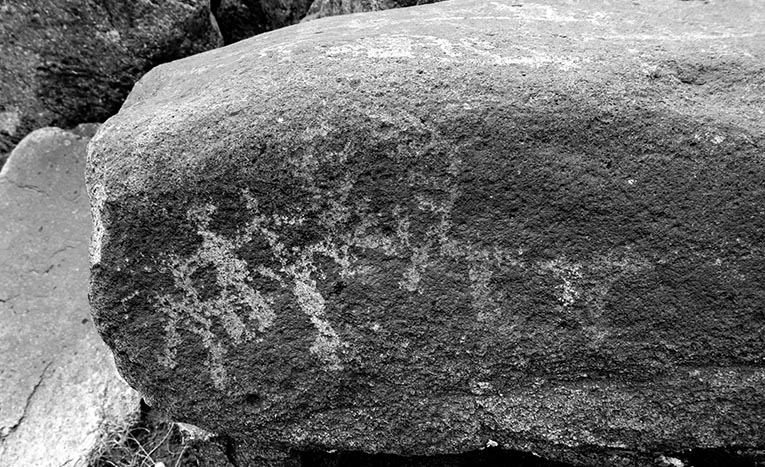
Figure 6: Anthropomorphic figures riding a zoomorphic figure with multi-tined horns

It is critical that such priceless artefacts are documented, studied and conserved. It is in this context that Ladags Norskal plays a pivotal role. Initiated by the Ladakh Autonomous Hill Development Council, Leh (LAHDC, Leh), this pioneering project marks an important step towards preserving Ladakh’s past for future generations. It aims to document heritage sites and uncover forgotten narratives from villages across Leh district. Findings such as these highlight the importance of projects like Ladags Norskal, which combine oral history with on-ground research. By bridging memory and material culture, the project is meant to safeguard Ladakh’s tangible heritage while also ensuring that they are documented and shared with public. These findings were very promising as the villagers mentioned that the Indian Army had a base here between 1985 and 1999 but this site remained hidden.

By Jigmet Yangchen Katpa

Jigmet Yangchan Katpa is Research Manager at Ladags Norskal Project, LAHDC, Leh.

Photographs by Thinles Dawa

Field Researchers at Ladags Norskal Project, Rigzin Dolma, Thinles Dawa, and Stanzin Skaldan assisted with the fieldwork.
Uncovering the past: Losar’s Hashala

Every society and culture has its own method of calculating time and has developed its own calendar. The people of Ladakh follow the lunar calendar to mark various events and record history. One of the most important social events in the annual Ladakhi lunar calendar is Losar or ‘new year’. There are several rituals and practices associated with such celebrations, which are rooted in our history.

However, as observed by historian Rohit Vohra, Ladakh’s documented history doesn’t provide details for the period prior to the 11th Century. Most of what is known for this period is in the form of legends, myths, and folklores. One such folklore that still persists in Nubra and Purig is that of Cho Bongskang. Cho is a title given to elderly leaders in Ladakh, Bong refers to a donkey and sKang to leg. He was an oppressive ruler at Teble (possibly in present-day Baltistan) and had an invincible body made of steel. Once he asked his subjects to stitch a shoe for him. All of them stitched a pair of shoes for him but none of them fit him. The only pair that fit his feet resembled the hooves of a donkey and was stitched by an elderly woman. After this incident, he was called Cho Bongskang i.e. leader with donkey-like hooves.

He loved eating a goat kid and he would demand that villagers deliver a goat kid to his palace. Each family would take turns to offer a goat kid to him and this became a ritual in the village. One time, a woman offered a new-born goat kid whose mother died while giving birth to it. Since it did not have a mother, the woman had breast fed the goat kid herself. When this goat kid was served, Cho Bongskang loved its taste and devoured it. He was curious about the new taste but the cook was not able to provide any satisfactory answer. The cook summoned the owner and learnt that she had breastfed the goat kid, which had changed its taste. When Cho Bongskang heard this, he demanded that human children be served to him instead of goat kids. He reasoned that if a goat kid could taste so good due to human breast milk then human children would taste even better.

This cannibalistic demand sent a wave of horror through the village. They were already fed up with his oppression and cruelty and this demand proved to be the final straw. The villagers started conspiring to kill him. Ironically, none of the villagers knew how to vanquish the invincible Cho Bongskang. However, there was one elderly villager who knew that Cho Bongskang’s heart was made of lac (a resinous substance that melts when heated), which is why he was scared of fire. So, the villagers hatched a plan to kill him by digging a ditch inside the gate of the palace. The next time he went on a hunting expedition, the villagers lit juniper branches and chased him towards the palace. The plan worked as intended and he fell into the pit. The villagers then threw the burning juniper branches into it. This ended Cho Bongskang’s reign of terror and freed the people of Teble from his monstrous demands. Since then, they have been celebrating their new year with fire in a ritual that came to be known as Dong-Me (Me means fire).

The origins of this story seem to be lost today. However, the celebration of his death is still practiced in the form of rituals using fire. In Baltistan, people celebrate a festival called Me-phang (me is fire, phang means throwing) and in Ladakh, Buddhists celebrate the onset of Losar with fire.

Losar celebrations start from the 25th day of the last month in the Tibetan lunar calendar. This day is called Galdan Namchot. Since the Tibetan calendar follows the lunar cycle, the date for Losar keeps changing on the Gregorian calendar. Buddhists generally mark the night of Galdan Namchot by lighting butter-lamps around their homes.

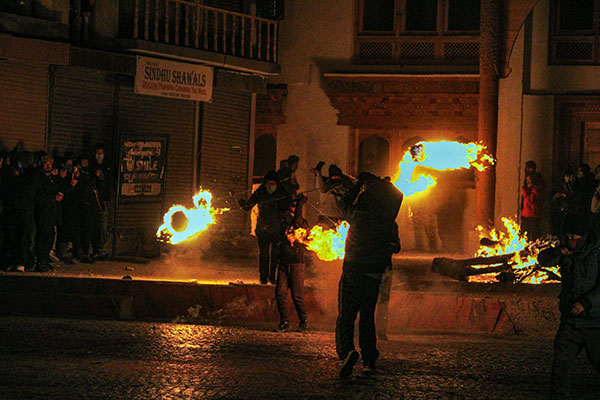
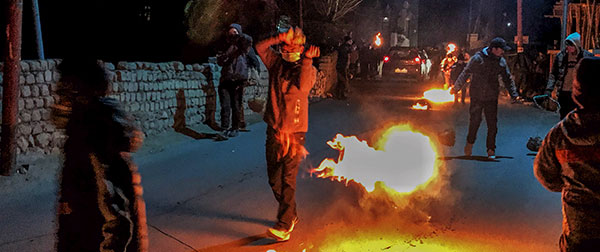
Similarly, they follow similar rituals on the night before Losar. The youth from the villages also practice a tradition of slinging fire, which is called Hashala. They stuff a few layers of jute bags soaked in kerosene, tie it in a knot and attach it to a chain. At night, once the monastery gives the signal by sounding a trumpet, musicians start playing Daman (drums). This is the cue for the youth, who light the knots on the jute bag and sling it around their head continuously causing sparks to hit surround surfaces and shining light around them. They run around the village in this manner and villagers encourage them by shouting, “Haishala-Hoshala.” At the end, they gather at a chosen point. In Leh town, they gather in front of the mosque built on the king’s land. Here they compete with one another to see whose fire lasts the longest.

Text by Jigmet Yangchan Katpa

Photographs by Jigmet Yangchan Katpa and Norbu Sponbo

Jigmet Yangchan holds a bachelor’s degree in Life Sciences and a master’s degree in Anthropology. She is currently worked on a project being implemented by Ladakh Ecological Development Group. Her instagram handle is @all_about_ladakh.