
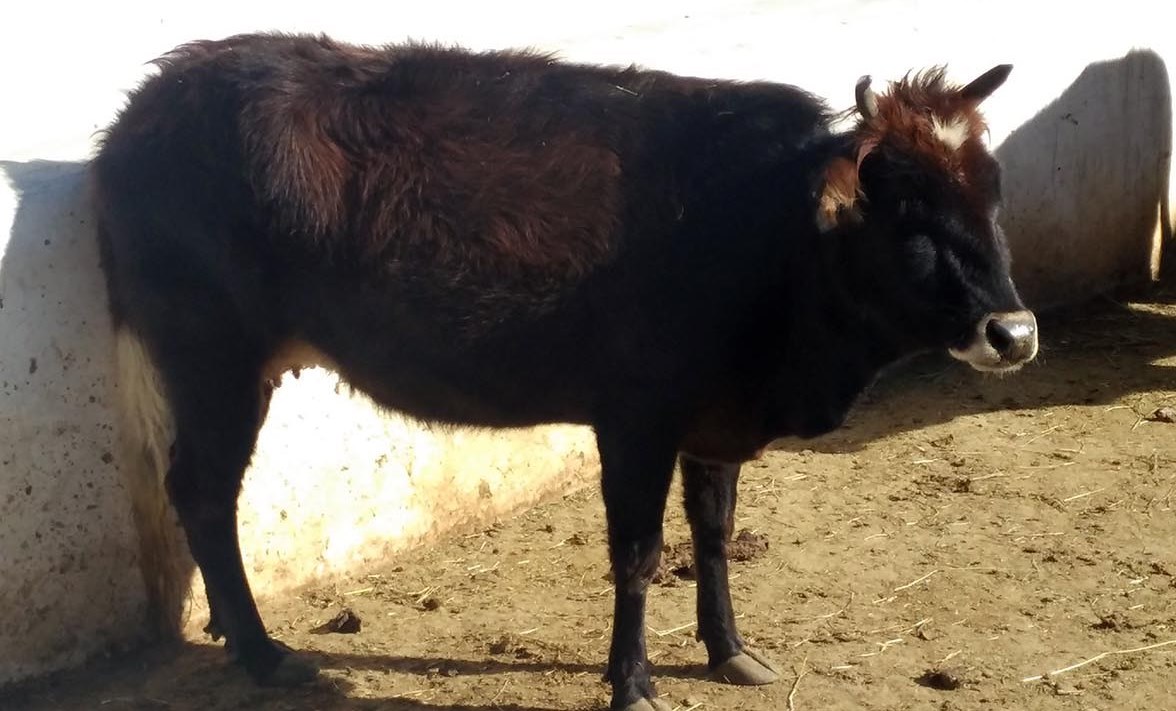
When in doubt, an ancient Ladakhi proverb wisely suggests that we should pay heed to what people do instead of what they say: Mi-sper la ma-nyan; mi-chos la stos. The wisdom of this proverb is evident in the saga of Ladakhi cows. Allow me to take you back a few years to help you understand the shifting fortunes of this humble but hardy animal.
In the 1970s, Ladakh was opened to visitors from outside and the introduction of modern technology. This included ideas of modernity and development. Ladakh had survived several centuries with its meagre population that was largely self-reliant and self-contained. During this period, the local Ladakhi cow was the major source of milk, which was used to produce butter, cheese, curd, and other dairy products. These animals were an integral part of each household and Ladakhi society at large. This was supported by pragmatic institutions such as bares, which distributed cow grazing duties amongst members of a village community. This ensured that there were norms of reciprocity within the village and no one was over-burdened with responsibilities related to caring for these animals.
Around the 1980s, there was a gradual shift in the way local cows were perceived. People started regarding them as a ‘low-yielding’ breed in terms of their daily milk output. This led to the introduction of high-yielding cows such as Holstein-Friesian (HF), which were actively supported by various research organisations and government departments.
Around the 1990s, the Jersey breed of cow was actively recommended at various forums, including seminars and workshops. We in Ladakh followed the general trend and started recommending Jersey as the most appropriate breed for Ladakh. Jersey was said to have a good yield and could be grazed on our pastures unlike the HF, which had to be stall-fed.
In the haste of increasing yields, which is considered a major factor of modern development, we introduced these two foreign breeds: HF and Jersey. In time they started replacing our local cow breed. These efforts were so extensive and carried out with such dedication that it has now become very difficult to find a pure-breed local cow in Ladakh anymore.
Then there was a twist in the tale of modernity. By the early 2000s, there were voices around the globe supporting the idea of small and local efforts for sustainability. This emphasised the need for local technologies and innovations, which were discussed at length at seminars and conferences.
Nowadays, our ideas of modernity are dominated by concepts such as ‘being local’ and adoption of ‘local ways’. In 2018, the Ladakhi cow was recognised as India’s 42nd breed of indigenous cow. It has taken us a very long time to appreciate and recognise the importance of being local and practicing local ways. Now, once again research and developmental agencies are recommending the adoption of local cows for local farming practices and arguing that it is appropriate for Ladakh. It is being argued that the Ladakhi cow is well-adapted and sustainable. Also, these animals provide us with a milk protein called A2, which is far better than the A1 protein found in the milk of the introduced breeds.
Ladakhi farmers are now in a dilemma about re-adopting the breed that the so-called experts dismissed for their low productivity and are now promoting for their adaptability and milk quality. Ironically, the past efforts of these researchers have ensured that it is now very difficult to find a pure Ladakhi cow—they are restricted to remote areas that are still untouched by modernity.
Photograph and text by Dr. Dorjey Angchok
Dr. Dorjey Angchok is a Scientist at Defence Institute of High Altitude Research (DIHAR). The views expressed in this article are his own.