
Pal and Zin: A reflection on Bhoti/Ladakhi language
This edition of Stawa was supposed to contain the twelfth episode of the serialised story. Instead, I am writing a reflection on it. Readers, I apologise for the interlude. The episodes of Pal and Zin tale are piecemeal in scope. Nevertheless, this article marks a year-long engagement between Dr Thupstan Norboo, Stawa, and me. Therefore, it felt fitting to relate the story behind its origin and writing about the process so far.
The genesis of the bilingual serialised fiction could be traced back to a conversation between Editor of Stawa, Sunetro Ghosal, and me about Bhoti/Ladakhi/Tibetan language. We discussed many facets of the language, including its dwindling fortune, seeming irrelevance in an increasing mono-cultural and mono-lingual world and blatant policy jinx. The rampant linguistic and cultural purge in Tibet and seemingly benign and yet chronic political apathy in India are only hastening its inevitable extinction. Nevertheless, the hour-long peripatetic exchange brought to the fore the dearth of fiction or literature in Bhoti/Ladakhi language. A jarring gap, we realised, could be addressed at our station instead of lamenting over its dismal situation.
The Tibetan plateau, the linguistic fountainhead of Bhoti language, culturally gave precedence to philosophical undertakings through a concerted royal patronage during historical times and spiritual reverence of the populace, in general—a collective choice that effectively relegated Bhoti literature to a lesser kind. In effect, the corpus of literature in Bhoti is largely philosophical in content with a typical terminology that is technical and specific, firmly embedded into the structural mores of Buddhism. The monolithic set of philosophical vocabulary, thus, serves the purpose of thought well, but not so much when it comes to the evolution of the language.
Akin to any other language, Bhoti is inherently fluid and amorphous incorporating a multitude of human experiences beyond the concerns of a marshalled philosophy. Yet, it lacks a literary platform, in terms of production and consumption, where those experiences could be experimented, exercised and expressed, facilitating a dynamic lexicon accrual in keeping with the changing world. Consequently, in the shared memory of Tibet and contiguous regions abutting the Himalayas, serious written works of fiction in Bhoti is sparse, save a few recent publications from Library of Tibetan Works and Archives, Dharamsala, India and Kham region of Tibet, which emanated during an ephemeral cultural revival period beginning the 1980s, under the vigilant watch of Chinese Communist Party.
Understandably, the existential threat for Bhoti is not peculiar to Ladakh. The larger Tibetan community, in exile or otherwise, is also reeling in its wake. Yet, Bhoti literature, the bedrock for the language, is still a second thought in the social consciousness of its linguistic demography despite its conspicuous absence and the central role it could play in its survival, though, the odds of which is fretting away each passing day. It is in this backdrop ‘Pal and Zin’ was conceived and written. The narrative is addressed to children in the hope of attracting young minds, but more so to keep the complexities of its language, plot and translation to its bare minimum.
As the reader is aware, each episode of the serialised narrative is published in English and Bhoti/Ladakhi, and the latter comes with an appendage of word-meaning section. While a language is multi-faceted with aspects such as syntax, style, voice and so on, this article primarily concerns itself with vocabulary. The idea is to accentuate the nature of language through the admixture of words that Bhoti/Ladakhi acquired over a prolong exposure to a potpourri of cultures, languages and ideas criss-crossing Ladakh.
Most of Bhoti/Ladakhi language words have their origins in native language drawn from pre-historic Trans Himalayan linguistic roots. Before Thonmi Sambhota codified it in the Seventh Century CE, the Tibet plateau (Zang Zung) spoke the language for centuries. It also acquired words and expressions from foreign languages such as Chinese, Kashmiri, Arabic, and Persian. These indigenised foreign terms are yet to find their place in its lexicon. In this regard, etymological research could prove an effective contribution towards Bhoti/Ladakhi development.
The list of Bhoti/Ladakhi terms discussed so far in the story includes words that are familiar in the written form of the language; some have their secondary or tertiary meanings faded away due to disuse; those which have been forgotten in spoken language altogether and have been replaced by unassimilated loanwords from languages such as Hindi, Urdu and English; colloquial words have firm roots in the written language albeit with pronunciation alterations; those which are purely spoken; and new words that were devised by me using portmanteaus. In fact, many of the names of the characters have been inspired from blends, such as Skardha (a blend of Skar: star and Dha: arrow), Gothgyal (Goth: vulture + Gyal: king) and Dojom (Dud: evil + Jom: subdue), revealing aspects of the characters such as their species, personality, role in the story and so on. Blend words, therefore, play a prominent role in Bhoti language in creative expression, linguistic efficiency and, importantly, in invention of new words. This demonstrates the inherent flexibility and adaptability of Bhoti/Ladakhi language, which is a tool that is enriched and receives a renewed lease of life when we start exploring its potential for expression.
Bhoti was a phonetic language that has increasingly deviated from its original makeup. In its spoken form, the language has various pronunciation schemes prevalent across the Tibetan plateau. As we move eastward from Baltistan to Central Tibet, diglossia becomes pronounced. Even in Ladakh, we have a rainbow of dialects. Some of them still retain the puritan sounds, where some communities pronounce words true to their written forms, as in Kargili/Purgi dialect. In central Ladakh, it begins to metamorphose, while the Changthang region in the east uses a diglossic form of the language. The word-meaning section of Pal and Zin also discusses some words that have undergone different degrees of phonetic transformation. It is pertinent to stress that Bhoti/Ladakhi language needs a phonetic transcription system that could account for such a diverse set of its dialectic variations and would go a long way in unifying the language.
Finally, the role of literature cannot be over emphasised in preserving and promoting a language. It is an open secret that spoken language is learnt through listening, while written through reading. Without either of them, a language is rendered incomplete and destined to die. Think of the prominent languages of the world such as English, French, Chinese, Spanish, Hindi, Urdu, Bengali, Assamese etc.; they all have a rich literary traditions. Literature is a necessary condition, if not a sufficient condition, for a language to flourish. Bhoti/Ladakhi language, therefore, needs a body of serious literature that is drawn on mundane experiences and narratives as it has done extensively with esoteric and analytical realms. I hope, this small experiment with Pal and Zin not only provides a source of entertainment and occasional inspiration, but also initiates a conversation on Bhoti/Ladakhi language and its practices.
By Lhundup Gyalpo
Lhundup Gyalpo is the author of Betty’s Butter Tea - Stories from Ladakh.
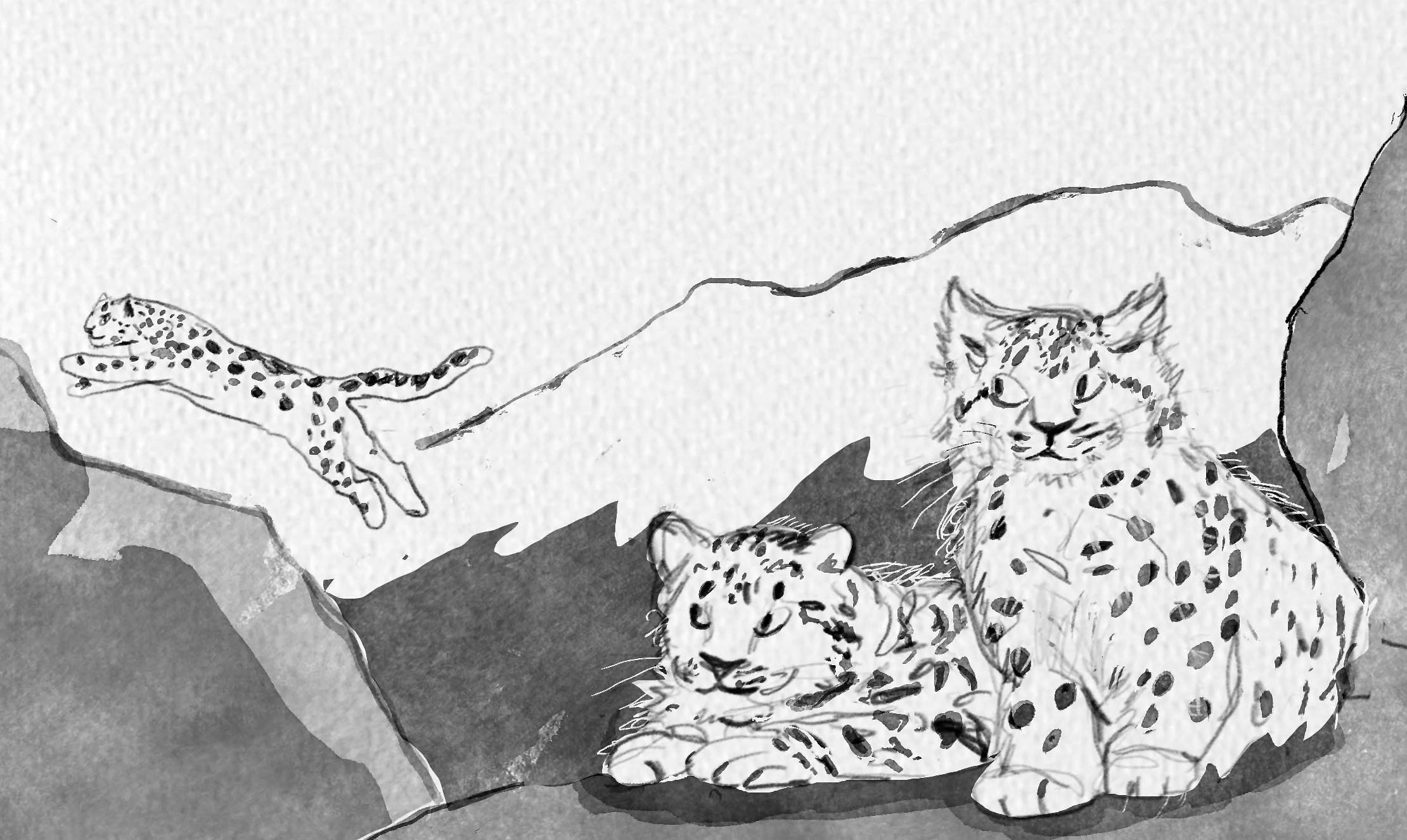
Sketch by Tsetan Angmo
Tsetan Angmo is a visual artist, a passionate illustrator and an animator with a flair for bringing characters to life through motion with a keen love for storytelling.
Lhundup Gyalpo’s reflection makes a compelling case that the future of Bhoti/Ladakhi depends not only on preserving its past but also on continuing to create in it. Pal and Zin is more than a serialized tale; it is a modest yet meaningful experiment in linguistic renewal. Every forgotten word revived, every new expression coined, and every young reader engaged is a small but meaningful investment in the language’s future.
The article rightly argues that literature is indispensable to the vitality of any language. At the same time, today’s digital platforms offer another important avenue for sustaining both language and cultural memory. In that regard, the work of culture- and folklore-based content creators also deserves recognition. A notable example is Acho Dorje, a former senior officer, whose Ladakh Through the Ages series, now comprising nearly 400 YouTube videos, has painstakingly documented Ladakh’s history, folklore, oral traditions, and cultural heritage in an engaging and accessible format. While such initiatives cannot replace literature, they complement it by nurturing interest in the language and the cultural world from which it draws its vitality.
Ultimately, preserving a language is not an act of nostalgia but of continuous creation. Its future depends not only on the stories we write, but also on the many ways we choose to speak, document, share, and celebrate it.