
Where mountains meet the sea: A Ladakhi voice at Fremantle Biennale
Ladakh has no ocean. Fremantle has no mountains. Yet, the two geographies converge at the Fremantle Biennale. Their convergence is not as opposites but as a dialogue stitched through memory, material, and the journey of water.
For the first time, Ladakh’s artistic voice has reached Australia’s western coast. At the 2025 Fremantle Biennale in Walyalup, the silence of the Himalayas meets the restless rhythm of the Indian ocean through a rare cross-continental collaboration. Under this year’s theme, Sanctuary, the partnership between Sā Ladakh Biennale, Ladakh Art and Media Organisation (LAMO), and the Fremantle Biennale becomes more than cultural exchange; it becomes a shared space of reflection, ecological storytelling, and artistic kinship.
Though this is an installation in a single exhibition room in Fremantle, the significance of this collaboration extends well past the walls. The artistic narratives of Ladakh have rarely travelled outside South Asia, let alone into a space where indigenous, oceanic, and global ecologies are already in conversation. For the Himalayan community, long viewed through lenses of tourism, conflict, and climate vulnerability, this is a moment that shifts the frame: Ladakh is here not as an object of study but as a contributor to a global cultural dialogue. The Fremantle Biennale is known for amplifying voices from places shaped by deep time, coastlines, islands, tidal histories and Ladakh’s presence extends that horizon. It lays a glacial landscape against the ocean, inviting viewers to consider how two worlds so apparently far apart are connected through climate, memory, and the movement of water. At a time when the global climate crisis often reduces whole communities to data points and headlines, this exchange insists on something more personal: that landscapes hold stories, and those stories deserve to be heard.
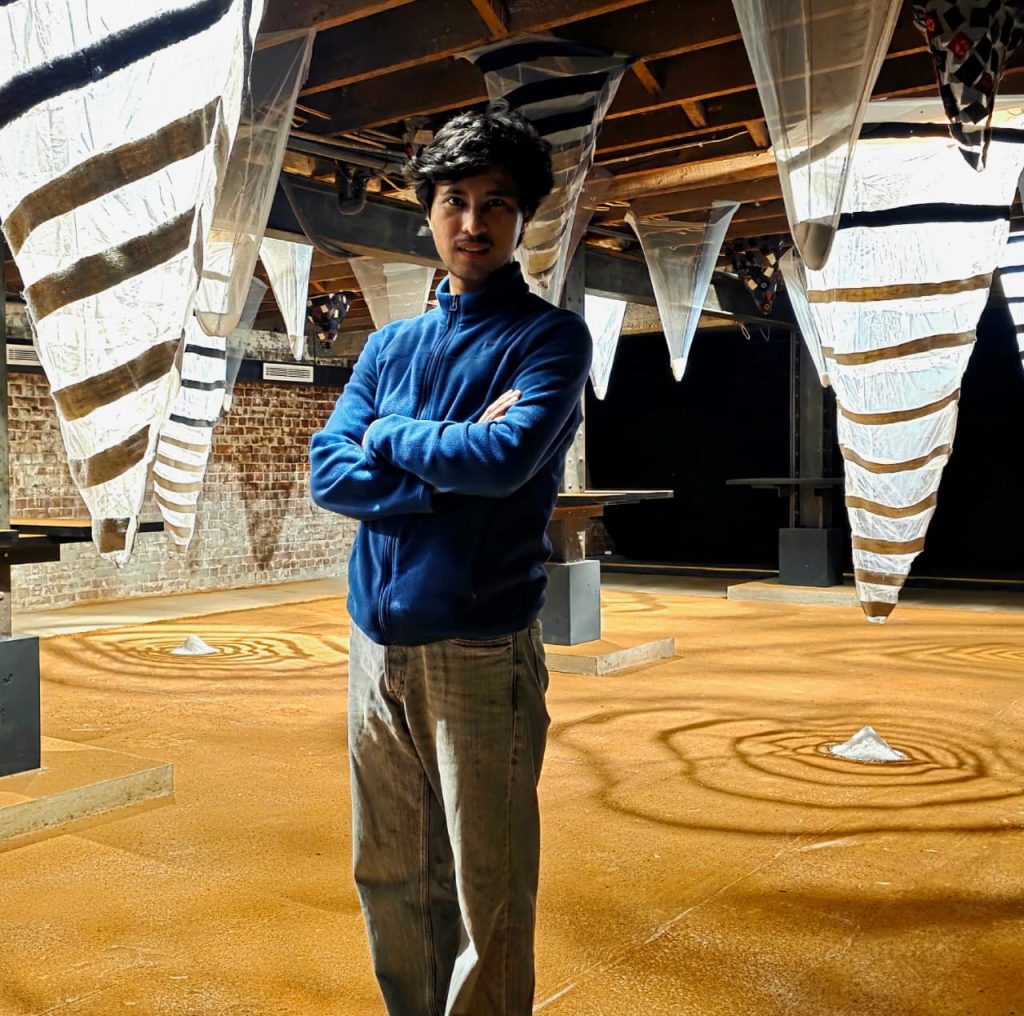
Ladakh is represented by sculptor Stanzin Tsepel from Rangdum, Zangskar, and interdisciplinary artist Arunima Dazess Wangchuk, who is based in Leh and Delhi. Tsepel, currently in residence in Fremantle, is developing a regenerative sculpture inspired by Ladakh's glacial terrains and the rhythms of the Indian ocean.
Stanzin Tsepel
Engaging virtually from Ladakh, Dazess expands the project through conceptual and digital forms, exploring spirituality, ecology, and technology for an onsite artwork to be executed by teams of the three art organisations. “In a world striving for a better future, the question remains—what does ‘better’ truly mean?” she reflects. “Our true future lies not in greed but in love and respect for our land and its people.”
This partnership brings together two ecologically distinct yet spiritually connected worlds: Ladakh’s glacial highlands and Fremantle's coastal horizon. It marks the first-ever representation of Ladakh at an Australian biennale, a milestone that opens new pathways for dialogue on ecology, identity, and artistic storytelling.
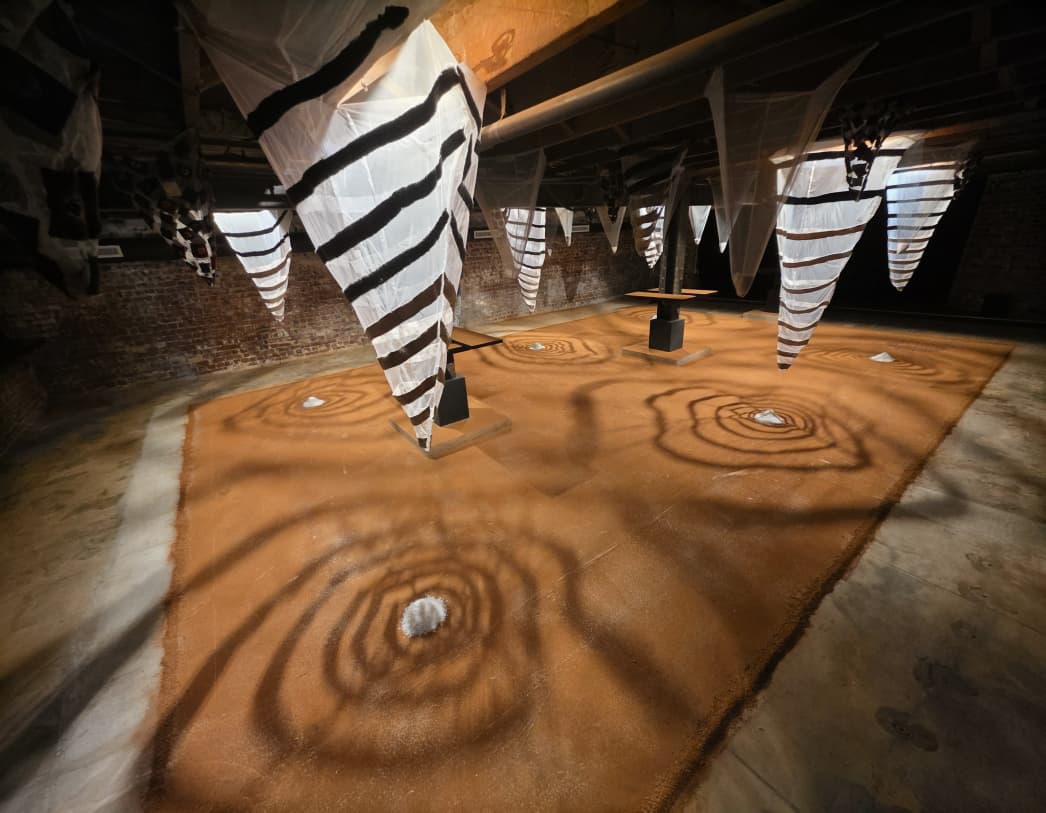
I wanted to understand the work and its making. I had a long phone conversation with sculptor, Stanzin Tsepel to discuss his work and the world it explores. His installation, Where mountains meet the sea, stands at the intersection of two worlds: The high-altitude quiet of the Himalayas and the tidal pulse of the Indian ocean. Rather than presenting contrast as conflict, the work treats difference as conversation, carried through water, memory, and movement.
Suspended textile forms crafted from Nambu, a traditional Ladakhi wool, hang from the ceiling. Cone-like and austere, their striped surfaces cast shifting shadows across the floor. The light behaves as though it recognises the material moving gently, almost tidal, as if the wool is breathing. On the ground lies sand and salt, which are subtle but unquestionable symbols of the sea. The combination creates an environment where altitude meets shoreline, glacier meets tide. Shadows ripple outward like slow-moving currents, echoing the long journey of meltwater from mountains to ocean.
For Tsepel, the installation is more than material composition, it is lived memory. He has grown up in Ladakh and he is now creating on the shores of the Indian ocean. In his own way, he carries memories of both landscapes. The work becomes a map of belonging. He calls it a regenerative sculpture. Rather than mourning loss, it looks toward continuity—toward the cycles that remain alive even in a time of change.
When I asked him about being the first Ladakhi artist to exhibit their work at the Fremantle Biennale, he said, “For me, representing Ladakh feels both like a responsibility and an honour. Coming from a remote Himalayan region, our stories are often unseen in global art spaces.”
We spoke about how glaciers entered conversations with the Indian ocean. He told me the idea wasn’t conceptual at first and that it emerged through working with the materials. The wool carried the mountains while the salt and sand carried the sea. At one point during installation, he simply stood there and realised that the dialogue had already begun. When I asked what feeling or emotion guided the work, he responded with one word, “Flow.” It was not only water but also movement through time, memory, and change. He explained, “A glacier isn’t just ice. It carries history.”
I wanted to know what Fremantle had offered him beyond the exhibition. His answer was not unusual but a bit surprising he said, “It isn’t the space, the scale, or the attention but the warmth of the people. Their patience and curiosity about Ladakh is not just as a distant mountain land but as a living culture.” I also asked what impressions he hoped visitors would take from his work. He said, “That the mountains and the oceans are connected. What melts in the Himalayas doesn’t stay there.” When I asked what comes next, he laughed but not out of uncertainty, but a sense of discovery. This installation has opened a new direction in his practice: Immersive spaces where the environment and experiences intertwine.
My last question was more personal: What would he take back to Ladakh, and what does he hope young Ladakhi artists can take from this moment? He replied, “I am returning with a deeper understanding that place shapes art. I hope that young artists in Ladakh realise their landscapes and their stories are not small but belong in global conversations.” As I looked at the images of the installation, I found myself pausing over the details, trying to imagine what it would feel like to stand in that space. The suspended cone-like forms reminded me of inverted mountains, almost as if gravity had shifted or memory had turned upside down. Their shadows ripple across the sand below, forming circles that look like the slow movement of water as if a glacier was melting, a drop at a time, creating rings that eventually find their way to the sea. Even through a photograph, there is a sense of quietness in the room, almost like a conversation taking place without sound. The small mounds of salt placed within those ripples feel symbolic, maybe of beginnings and ends, of glaciers and oceans, of memories and transformations.
Text by Deachen Chuskit
Photographs by Raki Nikahetiya
Deachen Chuskit is a reporter based in Leh.
Raki Nikahetiya is Co-founder of Sā Ladakh Biennale.