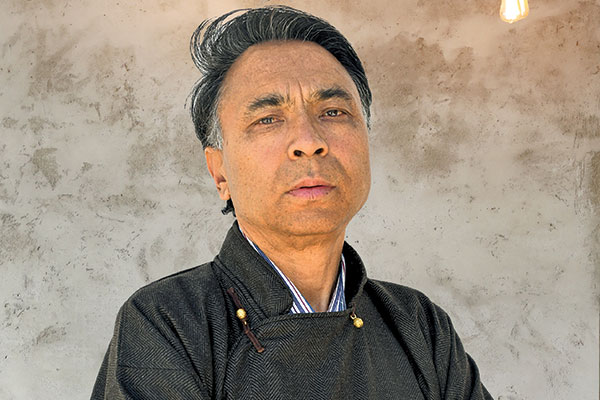
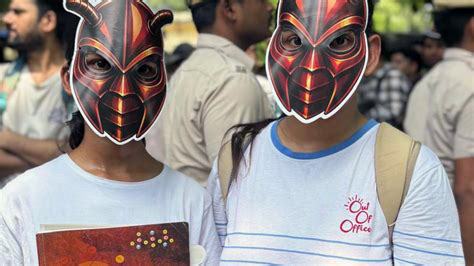
Interview: Member of Parliament, Ladakh, Haji Mohmad Haneefa Jan

Tsering Dolkar (TD): Congratulations on winning the election! What worked in your favour in this election? Did you expect to win by a margin of 27,862 votes?
Haji Mohmad Haneefa Jan (HMHJ): Thank you! What worked in my favour is that I had filed the nomination taking into consideration the issues facing Ladakh i.e. the four-point agenda. We did not draft a manifesto and let people know that I will focus on the four-point agenda for which the people of Ladakh, especially Apex Body, Leh and Kargil Democratic Alliance (KDA), have been fighting. I spoke on this issue with the people of Ladakh and it is on this basis that people had given me the mandate. I have received more support than I expected. We were expecting to win by a margin of 18,000 to 20,000 votes. Very few people have won an election by such a big margin in the history of Ladakh. People have showered me with a lot of love and support.

TD: What impact do you think communalism, regionalism and factionalism had in this election? How do you plan to bridge these divisions and unite Ladakh?
HMHJ: I don’t think these factors played any role in this election. The people of Ladakh did not vote on the basis of religion or region. The best thing about this election was that it was based on the issue of Ladakh. The regional divisions that have influenced previous parliamentary elections were not evident in this election. In Leh, there were two party candidates and I was the only candidate from Kargil. I received votes from Zangskar, Buddhist-dominated parts of Kargil district as well as different parts of Leh district. Thus, there was no voting on the basis of religiou or regional affiliations. After I won the election, I met people in Leh and Kargil and everyone was happy with the result as I had contested the election for Ladakh. I am committed to representing all the people of Ladakh and being the voice of Apex Body, Leh and KDA. I am thankful to everyone for ensuring that the election was conducted peacefully. Now it is my responsibility to be the voice of the people of Ladakh irrespective of their identity and to represent them in the Parliament.

TD: What is your vision for the next five years?
HMHJ: The first agenda is to initiate talks with the government on the four-point agenda. I believe that these issues can only be resolved through talks. The biggest challenge for me is related to the youth of Ladakh. They have been frustrated over the last four-five years and I intend to address the issues they face. We have to restore our recruitment procedures that have been dormant. The public service commission issue will have my full attention as our youth have been working hard for these jobs. In addition, every region in Ladakh has their own issues, I will be speaking to people from all regions in Ladakh to identify the issues they face and work to address them. There are a lot of things that need to be done. Overall, I will prioritise education, health and the welfare of our youth along with specific issues related to different regions in Ladakh.


TD: What are your priorities? How do you plan to further the agenda put forth by Apex Body, Leh and KDA?
HMHJ: As I mentioned, I will focus on the four-point agenda. In addition, I will prioritise issues related to the youth of Ladakh in terms of ensuring they have access to livelihood opportunities along with restoration of UT level recruitment to fill vacancies in Ladakh. I will also focus on the health sector to strengthen the district hospitals along with the health system across the region. I will also try and identify other issues facing Ladakh as well as different regions that require attention. I have been a founding member of KDA. Once KDA and Apex Body, Leh came together, they were able to unite the people of Ladakh to start thinking about the future of Ladakh. I will take this forward along with the leadership in Apex Body, Leh and KDA. I will continue consulting them and working with them to secure Ladakh’s future.

TD: How do you plan to work with the government as you are an independent? Do you think this will hinder the aspirations of the people of Ladakh?
HMHJ: I am confident that we can resolve these issues through talks with the government. I believe that in the past five years the reality experienced by the people of Ladakh may not have been communicated to the government properly. My first priority will be to meet with the Minister of Home Affairs. I have to communicate the concerns of the people of Ladakh in clear terms to the government. I am confident that if I am able to take this message from the people of Ladakh to the government, they will act in the interest of the people of Ladakh and for the people of Ladakh. As far as being an independent is concerned, for me the most important thing is the four-point agenda. In this regard, I will be speaking to the members of the government as well as the opposition in the Parliament. I have to discuss it with everyone. It is important I present the issues faced by Ladakh to everyone in a clear way. The general public of Ladakh elected me and I represent all of Ladakh. Thus, irrespective of who is in the government, we have to think about the mandate from the general public and work to protect their interest. So, once the government is formed I will start meeting different people including the Prime Minister, Home Minister, and everyone who can help Ladakh.

TD: There have been some differences in the demands that have emerged from Leh and Kargil with regard to the future of Ladakh. How will you build consensus on Ladakh’s future?
HMHJ: Apex Body, Leh and KDA have developed the four-point agenda together. It focusses on restoration of democracy, statehood, constitutional safeguards under Sixth Schedule and creation of Ladakh Public Service Commission. Leh and Kargil are united on the four-point agenda and that will be my focus.

TD: There were significant rifts in the political arena before the election across all parties. You were District President of J&K National Conference (NC) in Kargil. Did the party high command pressure the Kargil unit to support the INC candidate that led to the resignation of NC members in Kargil?
HMHJ: Yes, there was pressure from the party high command. That’s why all the members of J&K NC in Kargil resigned from the party. I had already resigned after people had united and chosen me as the candidate. The J&K NC leadership had its own priority while I prioritised Ladakh and our unity. When they pressured us, we informed them that we support the interests of Ladakh and if they persisted, we would be compelled to leave the party.

TD: Anything you would like to add?
HMHJ: We have made promises to the general public of Ladakh. I pray to the Almighty that I am able to meet the expectations of the people and fulfil the promises I have made with regard to the four-point agenda. I will work with full honesty and commitment over the next five years for the people of Ladakh to address their development and various issues related to Ladakh. I do not know how successful I will be but I will do my best to fulfil the expectations of the people of Ladakh and ensure that the future of the region is secure.

By Tsering Dolkar

Analysis: Ladakh’s Sixth Schedule demand

Once Ladakh was declared a Union Territory (UT) on 5 August, 2019, its governance came directly under Government of India. Earlier, when Ladakh was a part of the J&K state dominion, it barely received any importance or exposure to understand the meaning of good governance. As a result, the UT of Ladakh was not really prepared to take over the burden of governance on its own and required the support and assistance of Government of India. Many would argue that this was the reason why the UT of Ladakh was not granted a state legislature. Even if one does agree with this argument, one cannot deny that a time will come when the UT of Ladakh would need a Legislative Assembly.

Many sections of Ladakhi society have embraced the decision of Government of India to declare it a UT after abrogating Article 370. However, the journey does not end here as there is mutual responsibility for Ladakh and Government of India to improve coordination, enhance development, and deliver good governance.

Today, the people of Ladakh need safeguards to protect their culture and environment. The people of Ladakh, especially in Leh district, have time and again requested Government of India to invoke constitutional provisions to protect this unique region. The relevant laws governing such safeguards are already prescribed in our constitution along with the manner of its execution. There is thus no need for any new legislature in this regard. The Constitution of India lays down clear conditions under which a region can be considered for these provisions. This includes preservation of cultural identity and environmental heritage.

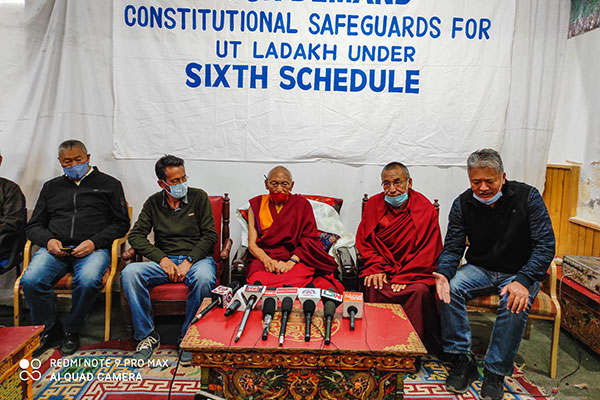
More than 98% of the residents of Ladakh belong to a constitutionally recognised tribal group, which is one prerequisite for the purpose of invoking the safeguards. Ladakh does have a distinct culture deeply intertwined with its delicate environment. In this context, recognition under the Sixth Schedule of the Indian Constitution is the most practical approach to safeguard Ladakh’s culture and environment.

Ladakh has Ladakh Autonomous Hill Development Councils (LAHDC) in Leh and Kargil. These need to be reformed and empowered to make them at par with the Autonomous Development Councils (ADCs) under the provision of the Sixth Schedule. The ADCs/LAHDCs under Sixth Schedule will function independently, without the need for a separate state legislature, with the approval from the Governor/Lieutenant-Governor.

Moreover, under the provision of the Sixth Schedule, the empowered LAHDCs will not only have executive function but also enjoy legislative, civil and judicial powers. They will be able to enact laws on matters such as land, forests, fisheries, and social security with due approval from the Governor/Lieutenant-Governor.

Critical analysis of current frameworks suggests that governance in Ladakh can function more effectively within the ambit of Sixth schedule with support and assistance from Government of India even in the absence of a Legislative Assembly. The LAHDCs are much closer to their constituents and are more acutely aware of the needs of the people and their interests. The Hill Councils are also better acquainted with the vulnerabilities of the environment. Thus, a more empowered version of LAHDCS along the lines of ADCs will be able to work more efficiently to safeguard the welfare of the region. Finally, the current structure of governance where Ladakh is divided into two districts, blocks and then villages blends effortlessly with the provisions of the Sixth Schedule.

One alternative to invoking the Sixth Schedule is to bring Ladakh under Article 371, which grants special provisions to states, but this is not practically feasible for various reasons. For instance, Article 371 (A-J) specifies provisions for specific regions. This implies that Government of India will have to enact additional categories to specify suitable provisions for Ladakh as it cannot club it with any of the existing categories currently mentioned in Article 371 (A-J). Furthermore, the provisions of Article 371 are so peculiar to their respective regions that none of them would be suitable for Ladakh due to the unique characteristics of the region. In addition, all the states under the provision of Article 371 have their own state legislature, which Ladakh currently lacks. For instance, Article 371C covers the creation of a committee for the functioning of the Legislative Assembly with members elected from the hilly regions of the state (Manipur). This section would not be applicable to Ladakh under the current framework as it does not have a Legislative Assembly or a corresponding institutionalised legislative framework as the LAHDCs currently function only as an executive branch of governance. Thus, Article 371 does not provide Ladakh with the safeguards that it requires.

Another option that has been mentioned in these discussions recently is the one related to domicile law. The term ‘domicile’ refers to being a lawful and permanent resident in a particular jurisdiction. A domicile certificate is a document that allows a person to avail various benefits such as education facilities, jobs etc. through a resident quota in government institutions. Domicile status is not only acquired by birth but also by choice. The right to change one’s domicile by choice is done by residing in the place of choice with the intention of residing there indefinitely.

So would a domicile law provide Ladakh safeguards comparable to the ones available under the Sixth Schedule? In this context we need to consider several important points. The first point refers to the fact that one naturally acquires domicile of the region where one is born in accordance with the Constitution of India under its provisions for citizenship. However, when a domicile law is being formulated there is no guarantee that it will reflect the expectations of the natives of a region. In other words, the fate of the natives will depend on these rules and regulations, which are also subject to change without warning or consultation. In addition, Government of India can always make a separate law enabling aspiring non-natives to gain domicile status in a particular region with certain riders.

Thus, in the current framework the safeguards Ladakh requires can only be achieved under the Sixth Schedule of the Constitution of India. The Sixth Schedule is perhaps the most relevant provisions in the Constitution to safeguard identity while also enabling the functioning of tribal regions. This helps us understand why there has been a strident demand from certain sections of Ladakhi society to bring the region under the ambit of the Sixth Schedule.

Text by Hina Goney

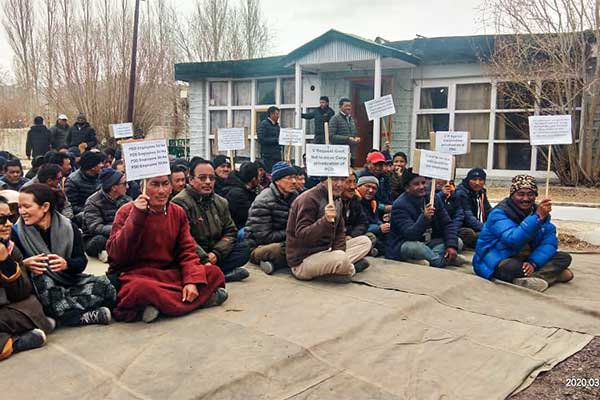
Photograph by Tsering Stobdan

Hina Goney holds a Bachelor of Law (LLB) degree and is based in Leh.

Shridhar Kaul and Ladakh’s UT discourse

Recently, the first anniversary of granting Union Territory (UT) status to Ladakh with the bifurcation of J&K state was marked on 5 August, 2020. This historical change has been greeted with joy and apprehension by the people of Ladakh. The sense of confusion remains even a year later. Over the last year, in addition to green signalling various developmental projects in Ladakh, the Bharatiya Janata Party (BJP) has been paying tribute to various people who have been instrumental in the struggle for UT status. The dominant narrative is that UT for Ladakh is the result of the efforts of a whole generation of Ladakhi society. In this regard, protests and public resentment in Kargil in the aftermath of the declaration of UT reveals a very different story. The divergence in aspiration of the people of Leh and Kargil has its genesis in the pre-Partition communal politics of J&K. In this period, the politics in the Indian Subcontinent was divided along communal lines. Many a time when Leh-Kargil relations are discussed, this historical phase and its reverberation in contemporary political discourse in Ladakh are omitted. One name that needs special mention for his role in shaping Ladakh’s political discourse is Pt. Shridhar Kaul.

Pt. Shridhar Kaul is popularly known as Pt. Dulloo or Master-ji. He was posted as Education Officer for Ladakh under Dogra rule. The current regime in Ladakh and J&K seems to have forgotten the contribution of Pt. Dulloo but that is unlikely. It is possible that the omission has been intentional for fear of belittling the contributions of Bakula Rinpoche and senior leaders such as Thupstan Tsewang and Tsering Dorjee Lakruk. However, this article does not dwell on why Pt. Dulloo has been excluded from the UT discourse. Instead, it explores his contribution in shaping the formation of the UT discourse in its early stages. Bakula Rinpoche has credited Pt. Dulloo for awakening the political consciousness of Ladakh and regarded him as a friend who used to guide him on important political issues pertaining to Ladakh.

The discourse of Ladakh, which later become entrenched in national and international imagination, as a Buddhist territory starts with the delegation of Pt. Shridhar Kaul and other Neo-Buddhist members of Kashmir Raj Bodhi Maha Sabha before the Glancy Commission in 1931. The Glancy Commission was meant to recommend ways to create a more democratic political framework for the state in the backdrop of mounting problems faced by the Dogra king. Ladakh was surely going to be affected by the outcomes of this commission. While the representation highlighted the plight of Ladakhi Buddhists before the commission, it overshadowed the entire Ladakhi Muslim population and their aspirations. The representation did not mention the socio-political conditions of Ladakhi Muslim community but clubbed them with the larger Muslim discourse of Jammu and Kashmir. However, the Glancy Commission rejected their proposal as the representation did not include any Ladakhi Buddhist leaders and moreover none of the member had ever been to Ladakh. Thereafter, Pt Dulloo started exploring other ways to reach out to Ladakhi Buddhists.

This became possible when he was posted in Ladakh as Education Officer, After assuming his responsibilities in Ladakh, Pt. Dulloo worked on a key objective of his Neo-Buddhist members, which was to strengthen the Ladakhi Buddhist community. As part of this group, he started the Ladakh Buddhist Education Society to improve education standards in Ladakh. They put forward many important issues pertaining to the Buddhist community including the appointment of a Bodhi teacher, special scholarships for Buddhist students and making Urdu an optional subject. It is important to acknowledge the contribution of Pt Dulloo and his associates in introducing the spark of modern education among the Buddhist community in Ladakh. In the religious and socio-political realms, the greatest achievement of Pt. Shridhar Kaul was the formation of Young Buddhist Men Association, which later became the Ladakh Buddhist Association. It remains the largest association of Buddhists in Ladakh.

Pt. Shridhar Kaul mentions in his book, Ladakh Through the Ages: Towards A New Identity that he was a member of various delegations to the J&K government and Government of India to demand autonomy, which later became a demand for UT. Similarly, he mentions the historic speech of Bakula Rinpoche in the J&K Assembly in 1952 that stirred a debate on Ladakh without mentioning that he had drafted that speech. The writings of Nawang Tsering Shakspo only mention that Bakula Rinpoche was very sad when Ladakh was not even mentioned once in the maiden budget session of the J&K Assembly in 1952. He discussed this with his mentor Pt. Shridhar Kaul to chart out a plan to protest against the J&K government for their step-motherly treatment of Ladakh. Tashi Rabgais, a veteran historian of Ladakh, has mentioned that he translated the speech that was originally written by Pt. Shridhar Kaul in English. He mentioned this during an interaction that was published in Heritage Himalaya (2011) under the title Khhaspa yang Zhunu (Scholars and Youth).Tashi Rabgais was a final year student in Kashmir at the time. This particular incident is significant in that it reveals that in this book, Pt. Kaul does not mention the ideas and policies that he had suggested to Ladakhi leaders. The writings of Kristoffer Brix Bertelsen, Martijn van Beek, Tashi Rabgias and Nawang Tsering Shakspo document the role of Pt. Shridhar Kaul in the demand for autonomy that later transformed into a demand for UT.

If we try to locate the role of Pt. Dulloo in Ladakh in the larger politics of J&K, it gives us a peek into his mind-set beyond him representing the Buddhists of the state. This needs to be seen in the context of the growing stature of Kashmiri Muslims at the cost of Kashmiri Pandits who were historically the ruling class in the state through the course of the 20th Century. This could have led Pt Dulloo and his associates to focus on ‘protecting’ this Buddhist belt from Muslim oppression. This would help unite all non-Muslim communities in the state, especially the Hindus and Buddhists as a counterweight to the Muslims of Kashmir valley especially in the post-independence era.

The book Ladakh Through the Ages: Towards A New Identity provides a coherent history of ancient Ladakh but its narration of Ladakh from 1930s to around 1950s seems rather biased. It reads like propaganda that paints Ladakhi Buddhists as illiterate and oppressed with no leadership while the Muslims of Ladakh are portrayed as recipients of opportunities and patronage from the Kashmir-centric regime. Moreover, he also writes that Muslims had a soft corner for the Pakistani army and initially rejected the proposal of joining the voluntary force of the National Guards unlike the Buddhist who were always ready to fight for India.

Just as he described the Buddhist community of Ladakh as illiterate and oppressed, he also expressed his emotional attachment and assumed his karmic duty to intervene in their welfare. There is no doubt on the immense contribution of Pt. Dulloo in saving Ladakh from the invading forces in 1947-48. Ladakh may well have been captured by Pakistani forces but for the intervention of people like Pt Dulloo who helped raise a voluntary force of local residents while also opening communication channels with Delhi. However, we must also not forget his role in the propagation of communal politics. The ideology of Muslim as outsider or the sympathiser of Pakistan or the enemy of Buddhist faith on the pretext of the political discourse in J&K and mainland India has shaped, and continues to shape, the political discourse of Ladakh. Unfortunately, the only window we have into the life of Pt. Dulloo is his book and research texts on Ladakh that touch on his contribution. We need more research into his life and how the politics of India and Kashmir influenced his outlook. This would help us understand his work and policies in Ladakh better in the light of these influences. These findings would help fill the void he has left in his book.

By Jamphel Sheyan

Jamphel Sheyan is a research scholar at Central University of Jammu

Understanding the India-China standoff in Ladakh

The Changpas are the nomadic community that lives in eastern Ladakh. They are generally the first to encounter soldiers of China’s People’s Liberation Army (PLA) near the Line of Actual Control (LAC) in the event of a face-off. Heavy snowfall in the winters, force the Changpas to leave valley floors and climb the mountains in search of winter grazing lands. Since there is no formal demarcation of the LAC between India and China in these remote areas, the Changpas often unknowingly move very close to the LAC where they may encounter PLA patrol parties.

This is how trouble started in 2008 when PLA troops asked a group of Changpas to move back and initiated a policy of ‘pushing back’ and following the trails of the Changpa’s winter footsteps. This resulted in an inch-by-inch intrusion of the Changpa’s winter grazing lands. In later years, these intrusions starting affecting the daily life of border villages and resulted in an increase of face-offs and even fist-fights between the Indian and PLA soldiers along the LAC. The current standoff between India and China on the banks of Pangong-tso and the massive build-up of Chinese troops on the other side of the LAC indicate a shift in policy from an ‘inch-by-inch’ intrusion to an all-out aggressive posturing. In this article I will try to trace the relevant signs and the impact of such standoffs on local communities.

Local perspective

Since the border has never been clearly demarcated, it leads to contested perspectives. This has become a major challenge for the Changpas and communities living in villages close to the LAC in Ladakh such as Demchok, Chusal, Dungti, Phobrang, and Chumur. These communities face a two-pronged problem: firstly, they are excluded from the benefits of development schemes due to the remoteness of the region wherein the local administration and others make little effort to reach them. Secondly, their proximity to the LAC has become a curse for them, especially in winters when the Chinese soldiers refuse to allow them access to traditional winter grazing grounds and keep a tight check on their movement.

So far, the modus operandi of the PLA has been to start patrolling the Indian side of the LAC. If they come face-to-face with Indian troops, it results in a faceoff. However, if they do not meet anyone, they leave behind conspicuous signs of their presence in the form of biscuit wrappers and other materials to strengthen their claim to the land. Such activities have been taking place in the frontier areas of eastern Ladakh but have largely been ignored and under-reported.

In 2008, Chinese soldiers uprooted the tents of the Changpas from their winter grazing lands near the LAC and drove them away. In an interview with NDTV after this incident, a Changpa proclaimed, “Last year this was our place, but now the Chinese Army has driven us away and uprooted our tents. This has made our lives very difficult.”

The pastures traditionally used by the Changpas and local villagers have been shrinking steadily due to the push back policy adopted by the Chinese army. Unfortunately, border patrolling units of the Indo-Tibetan Border Police (ITBP) and the army cite border agreement between India and China and prevent the Changpas and local villagers from venturing near the LAC in many areas.

These villages and areas lack basic amenities, which indicate the absence of interventions by the civil administration for developmental activities. In contrast, reports claim that that the Chinese have invested heavily in developmental work on the other side of the LAC. In 2018, villagers and nomads from Demchok, which is located along the LAC in eastern Ladakh, held a protest ‘over the lack of infrastructure and basic facilities (roads, communication, electricity, ration), and the restrictions imposed by the Indian army to even construct toilets or graze cattle in their own territory’. Such protests have been taking place for a while but the lack of media attention means these grievances rarely reach the relevant authorities. Communication technology remains very poor in these regions though locals report that cell phone and radio signal from the Chinese side are much stronger than Indian ones.

The standoff

The standoff between India and China near the Pangong-tso that started in early May 2020 has resulted in a full-scale troop mobilisation by both countries along the LAC in Ladakh. According to a recent report in The New Indian Express, “China initiated the standoff as an objection to road construction activity on the Indian side between Finger 3 and Finger 4 and also on an arterial ling [sic] to Galwan Valley being built as an offshoot from the 255 km long Darbuk [sic]-Shyok and Daulat Beg Oldi (DBO) road”. In Galwan valley, this road built by the Border Road Organisation comes close to the LAC and China is objecting to it. Pangong-tso is 135 km long and according to India, it controls around 45 km of the lake while the rest is under Chinese control. Along the northern bank of the lake, there are protrusions of land into the lake at many points, which are called fingers and numbered. According to India, the LAC passes through Finger 8 and it patrols till Finger 4. However, over the last few years, China has started patrolling till Finger 2 and has started stopping Indian soldiers from patrolling beyond Finger 2.

On 5 May, Indian soldiers proceeded beyond Finger 2 for their patrol when they were stopped by PLA troops. Since then, troops from the Indian Army and PLA have been engaged in a standoff along different points on the LAC. Such face-offs are not new as the two countries have a different understanding of the LAC. However, the Chinese are believed to be more aggressive. At the same time, sources report that China has also increased its infrastructure on a large scale along the LAC over the last few years. This has been corroborated by accounts from local Changpas and villagers on the Indian side of the LAC.

A month has passed now and the standoff remains unresolved. The two sides are engaged in dialogue but the standoff is expected to last longer than the one at Doklam in 2017 that lasted for 73 days. Furthermore, the scale of PLA deployment, which reports estimate to be over two brigade-strong, indicates sanction from Beijing and is not limited to local military commanders.

But why are the Chinese so desperate this time? According to a report in Hindustan Times, in military terms Chinese dominance and deterrence posture in the DBO sector is an effort by the PLA to prevent India from executing its plan for rapid border infrastructure development. This summer is believed to be the last chance for China to act as the Durbuk-Shyok-DBO road will be completed this year and significantly improve India’s capacity to rapidly deploy in the area near the LAC in Ladakh. This prospect worries China.

Conclusion

At least six rounds of talks have been held between Indian and Chinese military commanders on the ground to de-escalate the tensions along the LAC. However, these talks have failed to achieve any breakthrough. After these failed attempts of dialogue, the two countries are exploring politico-diplomatic interventions to diffuse the crisis. India has declared that it will not allow the ‘status quo’ to be changed unilaterally by the PLA. Prime Minister Narendra Modi’s Doklam team, which includes National Security Advisor, Ajit Doval, Chief of Defence Staff, General Bipin Rawat and Foreign Minister, S Jaishankar are back in action to diffuse the current standoff in Ladakh. This team had crafted India’s response to the Doklam standoff. Additionally, top commanders of the Indian army met for a three-day conference in Delhi in early May, where one of the main points for discussion was the ongoing standoff with China.

Some observers have pointed out that if the standoff is not resolved quickly through dialogue, it will undermine the progress that India and China have made over the past few years, especially through the two informal summits between Indian Prime Minister, Narendra Modi and Chinese President, Xi Jinping, first at Wuhan, China in 2018 and then at Mamallapuram in 2019.

Ladakh is geo-strategically very important for India as it shares frontiers with China as well as Pakistan and is also home to the mighty Siachen glacier that gives India a vantage point over Pakistan. In addition, Ladakh is also an important tourist hub. There are clearly no special developmental schemes for border villages that are at the frontline of such conflicts. The Changpas who graze their livestock near the LAC are the eyes and ears but we need to heed their complaints about the Chinese PLA, which have been ignored so far.

This suggests that a fresh Ladakh policy must be charted, which should include suggestions from local communities including ones who live in the frontier regions. We also need to bridge the void between frontier villages and the local administration. This standoff at Pangong-tso in May 2020 has highlighted the fact that things are not well along the LAC in Ladakh. Infrastructure development in frontier villages and their integration in the mainstream are some important steps that can be included in the new policy framework for Ladakh.

By Dr. Zainab Akhter

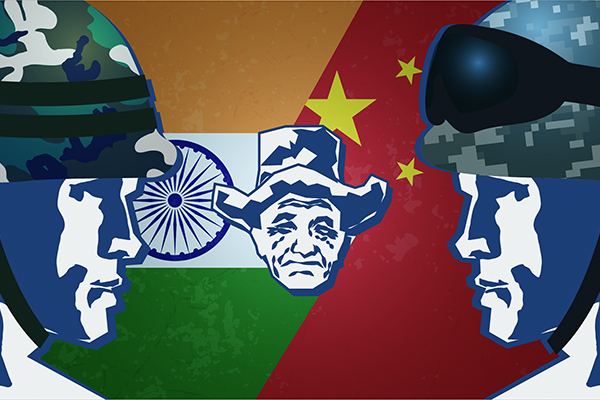
Illustration by Suhail Lone

Dr. Zainab Akhter works at the Manohar Parrikar Institute for Defense Studies and Analyses, New Delhi.

Implications of corporatisation of the power sector

Ladakh Power Development Department (PDD) was carved out of the erstwhile J&K Power Development Department and remains a fully-owned government department. The department’s role and responsibilities include buying electricity from power generating companies and selling it to consumers of different categories; domestic, commercial, industrial and government, to build transmission lines and supply electricity to remote rural areas i.e. rural electrification.

After J&K Re-organisation Act, 2019 was implemented, the State Administrative Council decided to unbundle the J&K Power Development Department (JKPDD) into J&K Power Corporation Limited (JKPCL), J&K Power Development Corporation Limited (JKPDCL) and Ladakh Power Corporation Limited (LPCL). Further, the Administrative Council proposed the corporatisation of Ladakh Power Development Department into Ladakh Power Corporation Limited.

Many people wonder why a government-owned power department is being converted to a public sector corporation. The Source of Power in Ladakh region with the installed capacity of 45 MW and 44MW Hydro Electric Projects, is owned by National Hydroelectric Project Corporation Limited (NHPCL) at Alchi and Chutuk in Leh and Kargil district, respectively and Northern Grid through 220/33KV Alusteng Grid Station in Kashmir.

At present, the ratio of domestic consumers to those in other categories is 80:20. The total power requirement during peak demand is 50 MW, and is met by 22 MW (Alchi), 4 MW (Chutuk) and 24 MW from Northern Grid during winter months from November to February. During these months, the total power generation from the above projects is drastically reduced due to less water in the Indus and Suru rivers. In the summer, the power requirements of Ladakh are fulfilled by Alchi and Chutuk projects and surplus power (around 40MW) from these projects is supplied to the Northern Grid.

The need to bring structural reforms by converting a government-owned department to a public sector undertaking was realised when studying the issue of energy loss. For instance, the cumulative annual energy pump of all the feeders is 150MU out of which 130MU is billed and 100MU is realised. The difference of 20MU is technical and 30MU is commercial loss. Collectively, 50MU is called Aggregated Technical and Commercial (AT&C) losses.

The technical losses can be reduced to an acceptable level by improving worn-out infrastructures such by replacing old conductors, transformers and rotten poles. Commercial losses can be controlled and monitored by implementing power reforms such as smart metering for all categories of consumers, feeder metering, distribution transformers metering, automatic data logging for all distribution transformer and feeders and Supervisory Control and Data Acquisition (SCADA) system and Distribution Management System (DMS) and IT application such as GIS mapping, consumer indexing etc. The use of smart meter/prepaid meter for various categories of consumers, billing and collection efficiency can be improved along with recovery of arrears. Like various service providers for digital TV and telecommunication, this mechanism works on advance payment for electricity.

Currently, 40% of AT&C losses are due to non-payment of electricity bills, power theft, un-metered consumers, and illegal consumers who are accessing electricity without registering their connections.  Many of these factors can be addressed by transforming a government-owned department to a public sector undertaking as a distribution company.

In case, these losses cannot be controlled by corporatizing the sector, the government may move towards privatising the sector. Operation and maintenance of power sector may then handed over to to private players, which may have an adverse impact on consumer tariff. The corporate/private sector is driven by profits and as part of their strategy to remain viable, privatisation will invariably lead to increase in tariffs and rationalisation of manpower by reducing the existing work force. Such processes of rationalisation will not only demoralise people but also increase the stress level of the remaining staff members.

Recently, there was a move to privatise the power sector in Bihar, which was opposed by employees who condemned the move. Bihar’s Energy Minister, Bijendra Prasad Yadav wrote to Union Power Minister, R K Singh on 13 February, 2020 advising against privatisation of the power sector. News reports mention that the power sector in Bihar has improved tremendously and achieved many of its targets within the expected time frame through the efforts of employees working in the sector. Transmission losses have reduced drastically from 60% to 29%.

The present tariff structure in Ladakh is subsidised. If we want this structure to continue, all electricity consumers must use power judiciously and support and co-operate with employees of Power Development Department to reduce losses to an acceptable level in accordance with guidelines of prevailing regulatory commission.

By Stanzin Toldan

Stanzin Toldan is an Assistant Engineer with Power Development Department, Ladakh